3.1 The VESA 75 frame
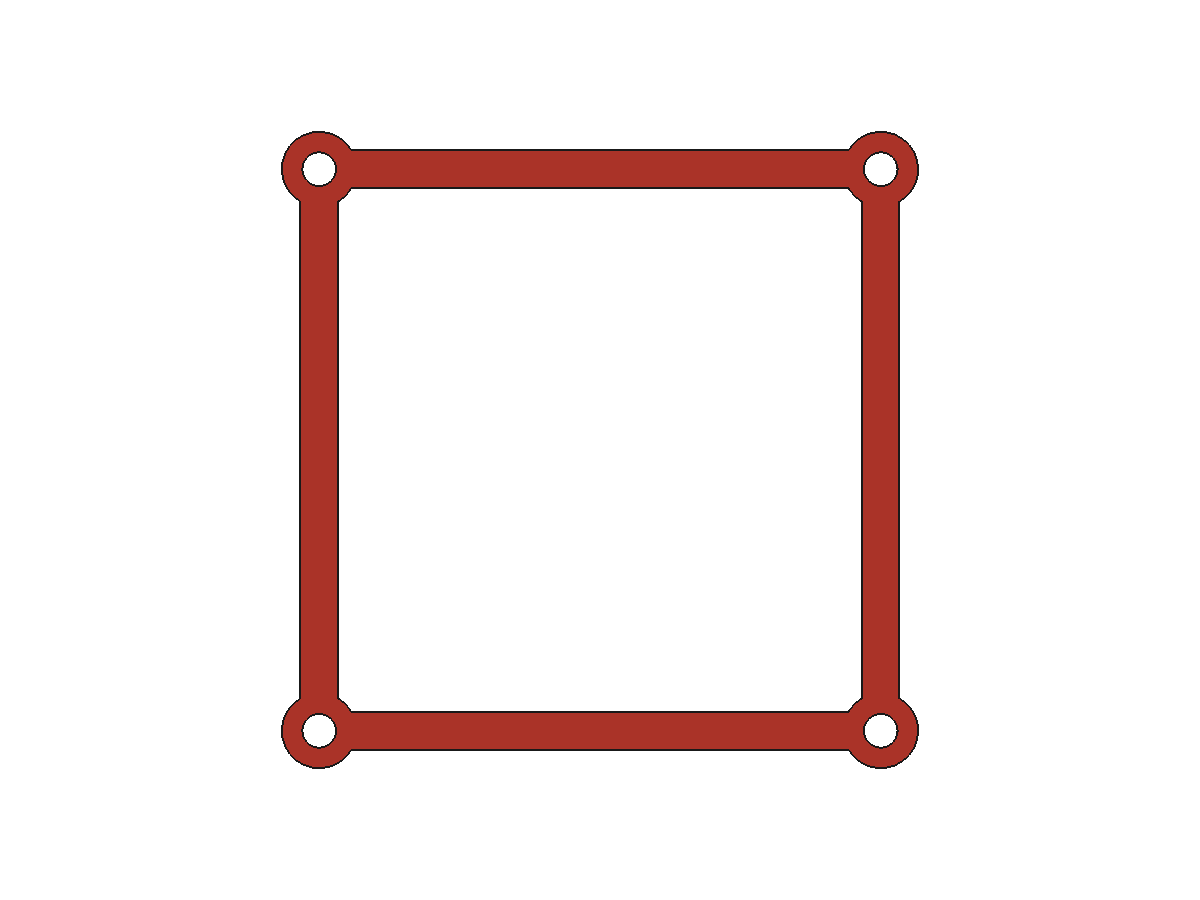
Plate to frame
Version 1 was a solid 87 × 87 × 3 mm plate with a window for the kickstand: 9.84 g and 17.5 minutes. My white filament was running low, and a gauge does not need a solid plate, so version 2 became a frame before it was printed:
| Version 1 | Version 2 | |
|---|---|---|
| Shape | Solid plate, 87 × 87 × 3 mm, window 52 × 71 mm | Frame, 85 × 85 × 2 mm: four 5 mm bars on the hole lines, a 10 mm boss round each hole |
| Volume | 11 440 mm³ | 3 118 mm³ |
| Slice | 9.84 g, 17 min 36 s | 3.64 g, 8 min 11 s |
The frame keeps every gauge function. Its 70 mm opening shows the whole kickstand recess, and its top edge stops at about 93 mm, below the back step at 96 mm, so it sits on the spine only. The holes are 4.5 mm (ISO 273 medium fit for M4).
One check detail: the script finds holes by their circular edges, and each boss has a concentric outer circle. Group circles by centre and take the smallest radius, or the check reports the boss as the hole.
Printing it
This was the first print sent by the agent, and the first attempt was the empty-nozzle job from 1.2. After the slicer fix, the second attempt loaded red from the AMS, purged the old white and finished all 10 layers. The first layer held on the textured PEI plate without bed levelling.
Results
- All four holes line up with the inserts.
- The thread is M4 in all four.
- Printed thickness 2.1 mm, for 2.0 mm designed.
- Usable thread depth: an M4 × 8 through the frame clamped snugly only with four washers (0.55 to 0.60 mm each) under its head. That leaves 8 − 2.1 − 2.3 = 3.6 mm of thread. With three washers it would reach about 4.2 mm, and it bottomed out.
So the inserts give 3.6 to 4.2 mm of thread, and I design for 3.5 mm. That one number set the screw for every later mount: an M4 × 10 countersunk through a 6.5 mm plate leaves exactly 3.5 mm.