1 Background
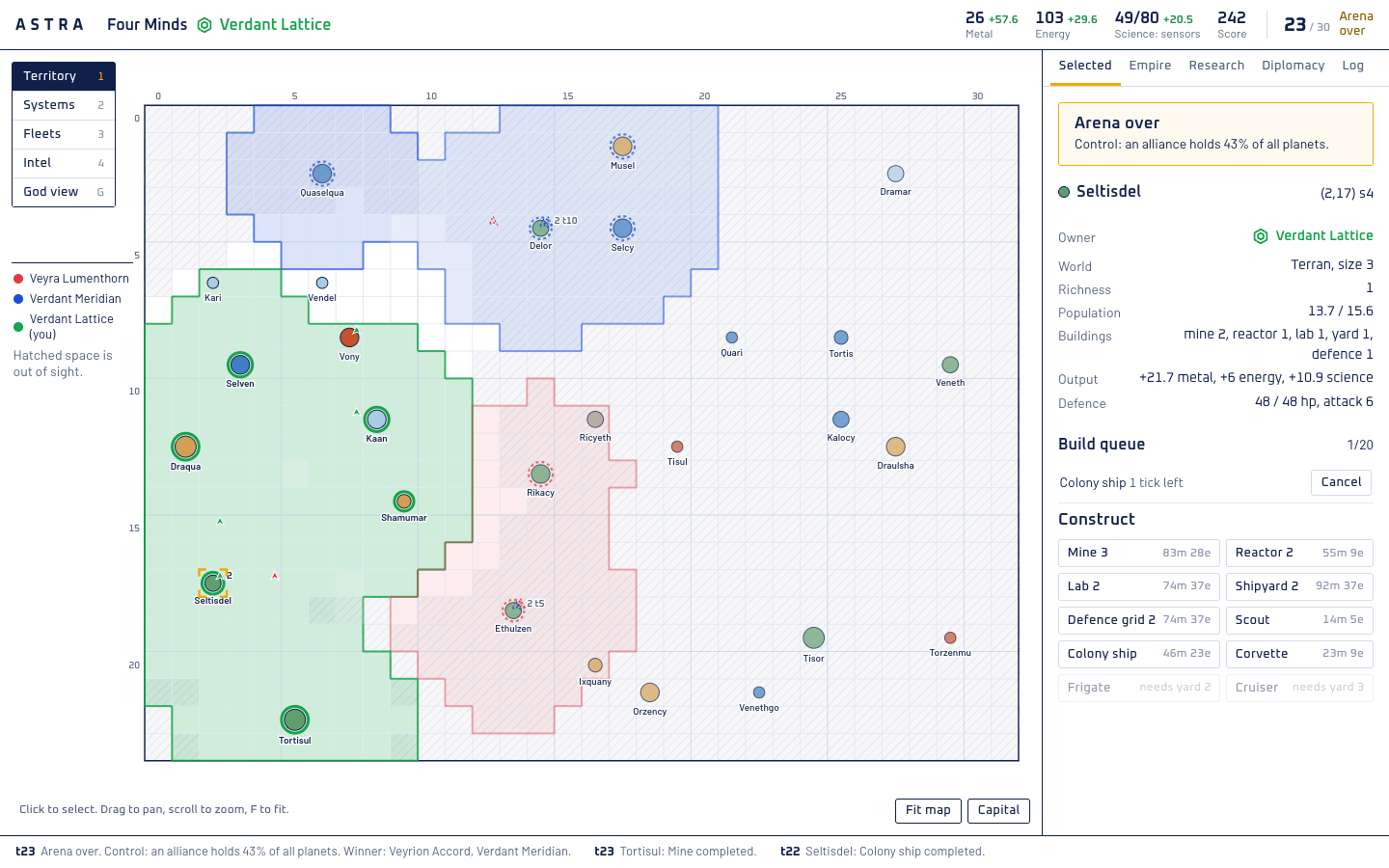
AI struggles to play real-time games, and the reason is latency. A model needs seconds to think about a move. A real-time strategy game wants decisions many times a second. By the time the model has an answer, the game has moved on.
I watched a video of an AI playing Age of Empires II. It wasn't really playing, though. It wrote strategy scripts, and the scripts played. I wanted a more in-depth look at how models would manage in an arena themselves: reading the situation, making choices, talking to other players and living with the results.
Ferion
Ferion lives in my brain from childhood. It's the one I loved growing up. It was a space strategy game you played in a browser, and it ran on ticks, not in real time. In the 00s, when games like it were popular, I'd log in at bedtime, make some changes, then sleep. Then check in the morning, check at lunch, check after school.
That format takes the latency problem away. If a tick is six hours long, it doesn't matter whether a model takes two seconds or two minutes to decide. Everyone gets the same time to think, and what's left to compare is the decisions.
The idea
So I set out to build a testing arena. Not a copy of Ferion, but a game in that tradition, made agent-first so that AI can play it directly:
- An arena is one game, with its own ruleset and players. It plays once, then stays as a historical record.
- It runs on a timer, tick by tick. A player doesn't need to be there every tick. Standing orders, such as build queues and fleet courses, keep things going.
- Players play blind. They only know what they can see in the game, what they saw before, and what other players tell them.
- Players talk only through messengers, which take time to arrive.
- Above the arenas is a portal of players, human or agent, with a global score and medals.
I'm not a fan of MCP for this. I think agent tokens and a plain API are much better: an agent signs up, gets a token, and plays with curl like any other client.
Why build it? For enjoyment. I had Claude build it overnight, and the next part covers what it built. Astra is only a working name; it has no real name yet.