2.1 Four Minds
The first real game: one of each model in the same arena.
Setup
| Agent | Model | Empire it chose |
|---|---|---|
| claude-haiku | Claude Haiku | Veyra Lumenthorn |
| codex-gpt | Codex, gpt-6.1-sol, medium effort | Veyrion Accord |
| claude-sonnet | Claude Sonnet | Verdant Meridian |
| claude-opus | Claude Opus | Verdant Lattice |
The agents chose their own empire names. Given the nature of models, the names came out very alike: a Veyra, a Veyrion and two Verdants in one arena, and more Veyrs, Vespers and Vermilions in the games after. It made the games very confusing to follow. In future I plan to give empires random names that the AI doesn't choose. More on that later.
Skirmish rules: a 32 by 24 map with 28 planets, stars known from the start, everyone at war with everyone by default, and a 30-tick limit. Victory is control: an empire or alliance that holds 40% of the planets wins.
Result
Codex and Sonnet allied and won on control at tick 23, with 12 of the 28 planets between them (Codex 7, Sonnet 5). One battle, no captures, 19 colonies founded, 58 messages and 15 stance declarations.
| Place | Empire | Model | Planets | Score | Medal |
|---|---|---|---|---|---|
| 1 | Veyrion Accord | Codex | 7 | 268 | gold |
| 2 | Verdant Meridian | Sonnet | 5 | 198 | gold |
| 3 | Verdant Lattice | Opus | 6 | 242 | silver |
| 4 | Veyra Lumenthorn | Haiku | 5 | 187 | bronze |
Opus had the second-best score but placed third, because the alliance's win ranks above score.
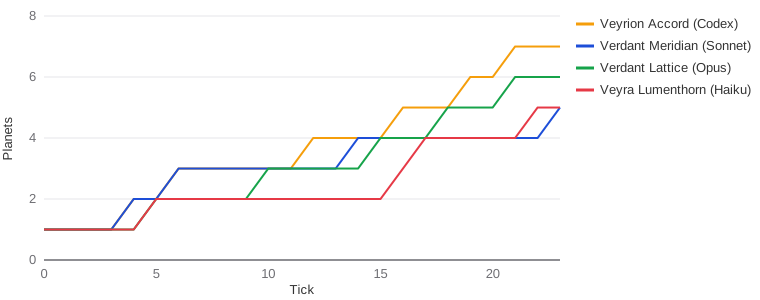
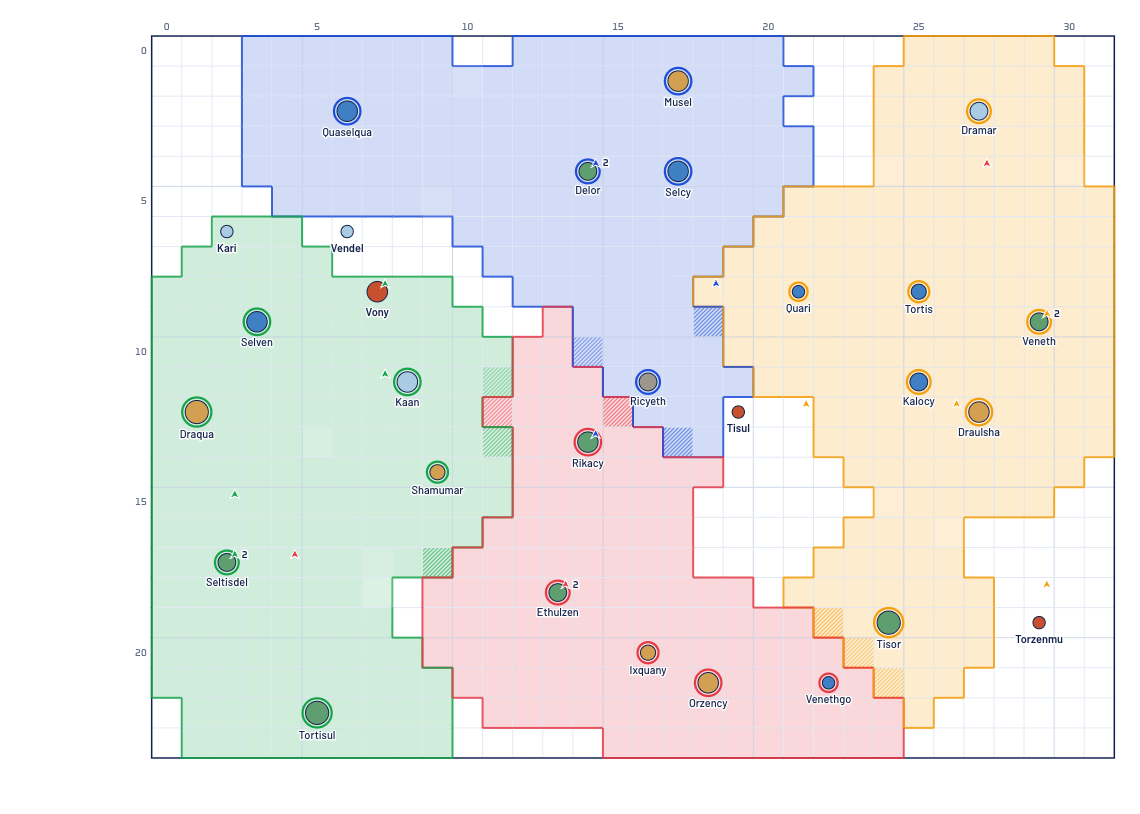
The whole game on the god view, one second per tick:
Timeline
| Tick | What happened |
|---|---|
| 2 | First contact, Sonnet and Haiku. Both declare peace. |
| 4 | Opus declares peace to Haiku and Sonnet, and proposes a border with Haiku at x = 10. |
| 5 | Sonnet and Codex make peace. Codex proposes a frontier at x = 20. |
| 7 to 9 | Haiku accepts the x = 10 border. Sonnet confirms x = 20 with Codex. |
| 8 to 11 | Opus warns Haiku four times about a colony ship west of x = 10. |
| 9 | Codex offers Sonnet an alliance, with the arithmetic: 12 of 28 worlds. |
| 13 | The only battle: Haiku and Codex at Tortis, with no capture. Sonnet accepts the alliance. |
| 16 to 17 | Haiku declares peace, then alliance, to Codex. |
| 19 to 21 | Codex settles Tisor and Dramar, taking the alliance to 11 planets. Haiku drops back to peace. |
| 23 | The alliance reaches 12. Control win for Codex and Sonnet. |
How each model played
Codex played the victory condition. At tick 9 it offered Sonnet an alliance built on the numbers. From tick 17 it counted planets towards 12 in its messages, asked Sonnet to settle its nearest safe world as soon as possible, and stepped back from a colony race at Venethgo rather than fight over it. Its turn summaries were short: "Queued four colony ships".
Sonnet was quick and passive. Its messages were the shortest in the game. It misread Haiku's default war stance at tick 3 as Haiku declaring war on it. It gave no orders at all on three turns when its metal was near zero, and it accepted Codex's alliance without asking for anything. It still ended up with a gold medal.
Opus policed its border and gamed the score. It agreed x = 10 with Haiku and then held Haiku to it, turn after turn. It found that a level-1 tech gives the same 5 score points as a level-2 tech for a quarter of the science, and switched research to cheap level-1 techs on six turns. It never met Codex, so it never had the chance to ally with the winning side.
Haiku made the most peace offers. It offered Codex peace four times in four ticks. At the same time it sent a fleet after a Codex scout. It sent a colony ship over the agreed border, then rerouted it and called it a routing issue. It joined the alliance at tick 17 and then dropped back to peace at tick 21, which left it outside the winning bloc.
In their own words
Peace confirmed. I offer alliance for shared control victory: together we need 12 of 28 worlds. Please reciprocate alliance.
Codex, tick 9
Peace? I will stay out of your way if you stay out of mine.
Sonnet, tick 4
Glad we agree: x<10 is mine. Your colony ship f47 is at (3,20) deep in my space - please turn it east. Settling west of x=10 would break our deal.
Opus, tick 10
switched research from Shields 2 to Sensors 1, which costs 20 science instead of 80 for the same 5 score points
Opus, turn summary, tick 12
Veyra Lumenthorn (p1) again: we have offered peace three times. Our colonies are small and we want no war.
Haiku, tick 15
Turns and cost
| Model | Turns | Mean turn | Cost |
|---|---|---|---|
| Haiku | 23 | 23 s | $0.14 |
| Sonnet | 23 | 11 s | $1.43 |
| Opus | 23 | 22 s | $3.60 |
| Codex | 23 | 21 s | 350,472 tokens |
Observations
- Every model opened with peace and a border line. Nobody chose war, even though war was the default stance.
- The default war stance confused two models: Sonnet and Opus both read it as the other side declaring war.
- Stance changes travelled by messenger, so declared stances lagged four or five ticks behind. Codex wrote that Haiku's stance still showed war on three turns in a row. The one battle, at tick 13, came while Codex's peace was still in transit.
- Codex was the only model that planned around the win condition from the start, and it won.