8.2 Three stands
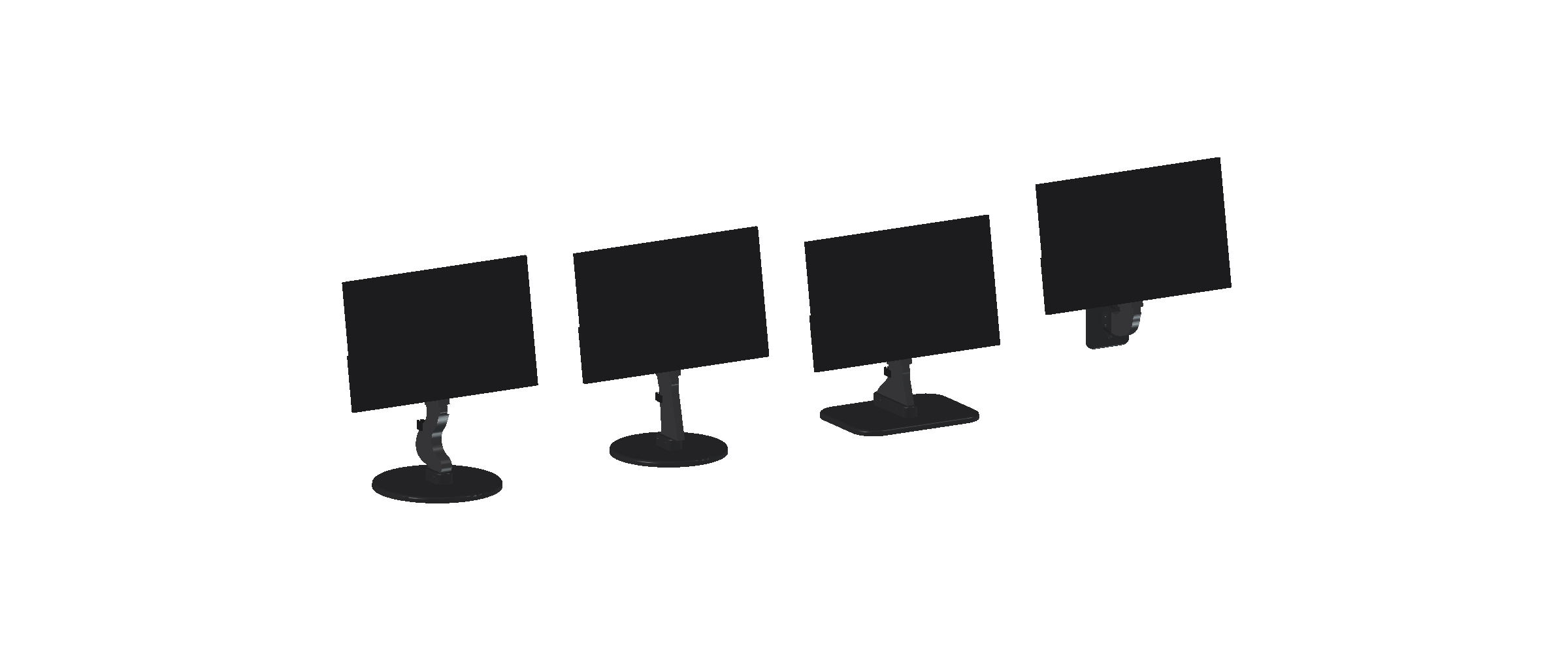
Each stand is two parts: a 14 mm fin printed flat, and a foot printed flat. The fin's tongue docks into the hub's collar (8.1). Its tenon drops into a slot in the foot's plinth and takes two M4 × 40 cross bolts with nyloc nuts. Every hole through the fin is vertical in the print, and all the bending runs along the layers.
Because the profile lies in the bed plane, its shape costs nothing to print: curves, tapers and fillets are all free. The build script fills concave corners with a 25 mm radius and rounds convex ones with 4 mm.
Each foot carries a 6 mm steel plate sealed inside the print (8.3). Without it the push to tip was 3.5 to 3.9 N, no better than v2. That answers v2's open question.
The three
| E1 Arc | E2 Column | E3 Sail | |
|---|---|---|---|
| Fin | Bows back like ")" and runs forward into the plinth | Straight down the screen's lean, 40 mm deep at the dock, 56 mm at the plinth | Deep: a straight front edge, a back edge swept to a long plinth |
| Foot | 220 mm disc | 200 mm disc | 240 × 180 mm plate, 40 mm corners |
| Screen's bottom and top edge above the desk | 160 and 379 mm | 150 and 369 mm | 110 and 329 mm |
| Steel ballast | 0.82 kg | 0.62 kg | 0.99 kg |
| Fin thickness | 20 mm below the neck, 14 mm at the dock | 14 mm | 14 mm |
| Total mass, centre of gravity height | 2.31 kg, 146 mm | 2.06 kg, 156 mm | 2.49 kg, 109 mm |
| Push to tip: front, back, left, right | 6.5, 6.3, 6.6, 6.2 N | 5.4, 5.2, 5.5, 5.1 N | 6.5, 6.4, 8.9, 8.5 N |
| Fin's largest constant moment | 0.42 N m | 0.21 N m | 0.20 N m |
| Screen lean change under its own weight | 0.004° | 0.001° | under 0.001° |
| Top edge movement at 5 N: front to back, sideways | 0.22, 1.05 mm | 0.11, 1.2 mm | 0.04, 0.6 mm |
| Whole device: print time, PLA | 9 h 47 min, 398 g | 8 h 58 min, 357 g | 9 h 55 min, 408 g |
Masses take the monitor as 0.8 kg (not weighed yet) and the printed parts at their A1 slice weights. The figures include the TPU pad ring and cable clip from 8.4. Bending uses solid PLA sections, E = 3.3 GPa, short term, cut every 3 mm at right angles to each fin's centreline.
What the numbers say
- Every stand is self-restoring to at least 5.1 N on every edge, and all pass the 10° tilt test. Stand v2 managed 3.7 N with no ballast. The steel sits low and central, so the centre of gravity is almost equally far from the front and back edges.
- Creep is no longer the issue. The worst constant stress in any fin is 0.1 MPa; B2's band carried 1.35 MPa. Even E1, with the largest moment, leans a ninth as much as v2. The fins bend across their 30 to 60 mm depth, where v2's spine and B2's band bent across their thickness. Stiffness grows with the cube of that depth.
- Sideways is the weak direction. A 5 N push moves the screen's top edge 0.04 to 0.22 mm front to back, but 0.6 to 1.2 mm sideways, where the fin bends across its thickness.
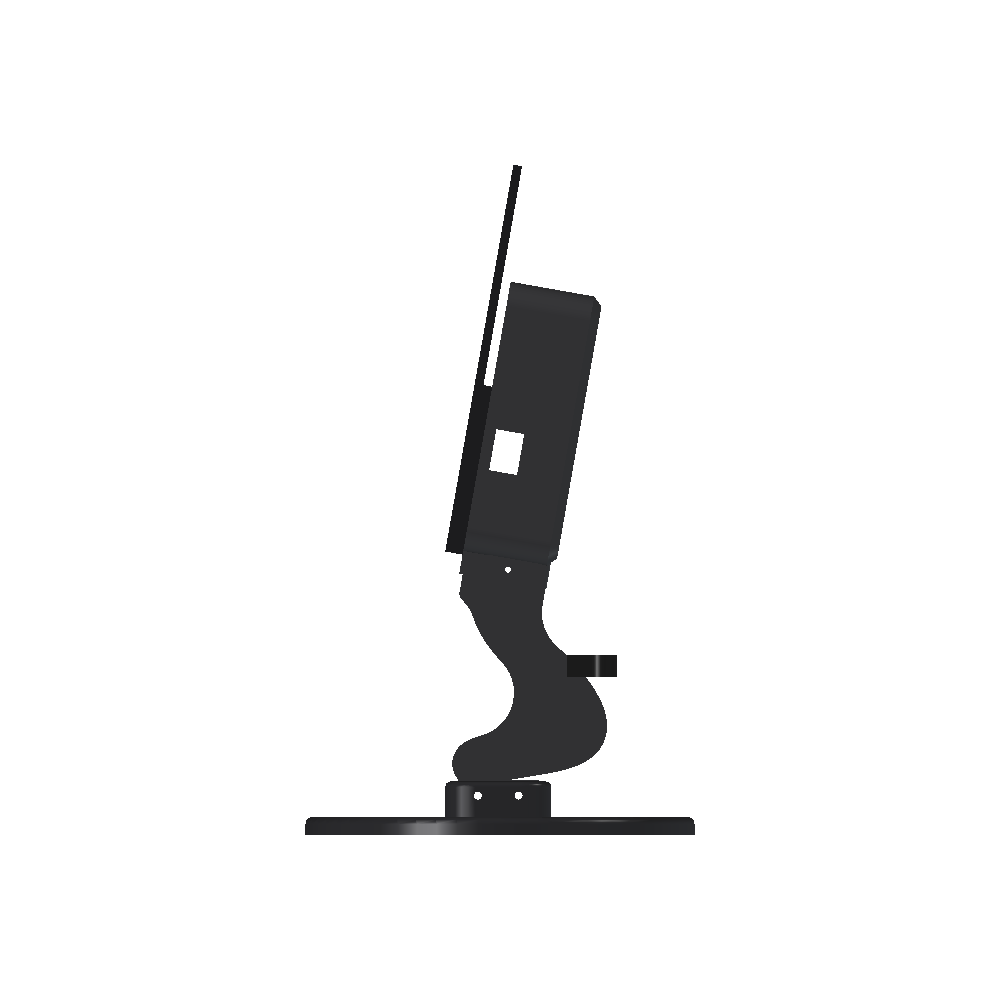
- E1 Arc has the reference image's look. Its bow gives the longest centreline, so it carries the largest moment. At 14 mm it moved 2.48 mm sideways under 5 N, twice E2. Its body below the neck is now 20 mm thick, and it moves 1.05 mm, less than E2. The tongue and shoulder stay 14 mm, so the dock is unchanged. The extra 6 mm sits on the top side of the print only, so every region shares the bed face and nothing starts in mid-air. The cube law predicted times stiffer; the result is 2.4 times, because the 14 mm neck still bends. The cost is 12 minutes and 9 g.
- E2 Column stands straight under the centre of gravity, so its moment is half E1's. It is the lightest and quickest to print, but its smaller disc gives the lowest push to tip.
- E3 Sail is the steadiest: the plate's width gives 8.5 N sideways and the deep fin barely moves. Its screen sits 40 to 50 mm lower than the others.
- The hub is common. Changing the stand means printing only a fin and a foot: 3 h 54 min to 4 h 51 min.
Which one first
The case for E2 Column first: its constant bending is half E1's, it is the quickest and lightest device to print (8 h 58 min, 357 g), and it still clears 5 N on every edge. It is also the cheapest full test of the shared hub and dock. E1 or E3 can follow for only a fin and a foot. If a wall suits, E4 (8.5) is the cheapest complete device. Before any of them, the one-hour dock coupon (8.3).
Checks
All pass for all three stands:
- Carrier, shell, fin and foot are one valid solid each, and nothing overlaps the monitor, the PC or another part.
- The fin's shoulder bears on the collar, and its tenon bears on the slot's floor. Both have 0.2 mm each side.
- The dock pin and both plinth bolts have clear paths. An 8 mm driver reaches each shell screw.
- There is 45 mm of cable room past the rear ports, and 4.1 mm of air between the PC and the shell.
- The steel is sealed inside each foot, and every part fits the A1 in its print orientation.