8.5 E4 Wall
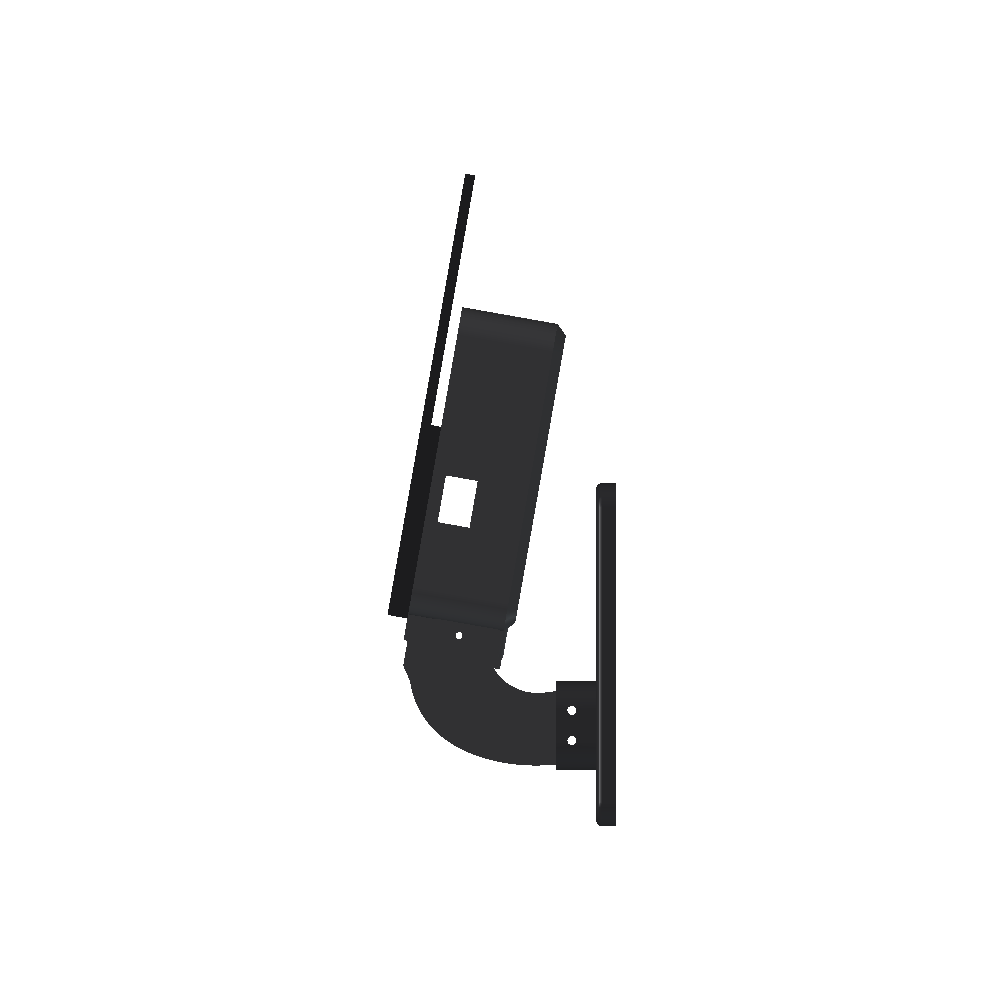
The shared dock pays off here. E4 puts the same hub on a wall instead of a desk: a short fin and a wall plate, with no change to the carrier, the shell or the dock. The hub moves between desk and wall by lifting it off one tongue and dropping it on the other.
Design
- Fin. Down from the collar, then back in a short curve to the wall. Its centreline is 94 mm long. It keeps the 14 mm flat print, the shoulder and the tongue.
- Wall plate. 80 × 170 × 10 mm with 12 mm corners, printed flat with the wall side on the bed. A plinth stands off its face. The seat is the floor-stand seat turned through 90°: the tenon slides in horizontally and bears on the slot's floor, and two M4 cross bolts locate it.
- Fixing. Two 4.5 to 5 mm screws into wall plugs, countersunk from the front, 130 mm apart, above and below the plinth. The plate reaches up behind the hub, so the top screw sits well above the dock.
- Gap. The wall is 15 mm behind the hub's back, so the vents and the cable bay still have air.
A different check
A wall mount cannot tip, so the self-restoring rule from 6 does not apply. The question becomes what the screws carry.
The centre of gravity sits 78 mm out from the wall. The plate tries to rotate about its bottom edge, and the top screw resists that as a pull. The check gives 6.8 N of pull on the top screw and 6.6 N of shear on each screw. Both are small loads for a screw in a wall plug, but the plug and the wall are the weak link, so use plugs that suit the wall.
Numbers
| E4 Wall | |
|---|---|
| Mass on the wall (no ballast) | 1.35 kg, centre of gravity 78 mm out |
| Fin's largest constant moment | 0.61 N m |
| Constant stress | 0.26 MPa |
| Screen lean change under its own weight | 0.005° |
| Top edge movement at 5 N: front to back, sideways | 0.12, 1.0 mm |
| Fin: print, PLA | 41 min, 25 g |
| Wall plate: print, PLA | 1 h 21 min, 59 g |
| Whole device (carrier, shell, fin, plate) | 7 h 6 min, 267 g |
E4's fin carries the largest constant moment in the range, because the whole hub hangs out from the wall on it. Its stress is still about a fifth of B2's band, and the screen leans 0.005°, about a seventh of v2. It is the cheapest complete device. Moving an existing hub to the wall costs 2 h 2 min and 84 g of PLA.
Problems on the way
- A tight curve made the offset cross itself. E4's first fin had a bend tight enough that the band's 2D offset looped over itself and enclosed about 6 times the right area. The build would have produced a wrong solid with no error. The band function now compares its area with width × length and fails loudly.
- The centreline doubled back into the plinth, so the bending check reported a section inside the supported tenon. The centreline now stops at the plinth's face.
Both are the same kind of problem as the false 18 MPa in 8.3. Geometry code fails quietly. A cheap sanity check against a known quantity turns that into a loud failure.