1 The project
We have two cats, and they use the downstairs WC for their litter trays. It's a small room and it can smell. As an engineer I see that as a problem to solve, not something to live with.
The plan
There are two parts:
- A cat flap in the WC door. The cats can come and go with the door shut, so the smell stays in the one room where the filter can deal with it.
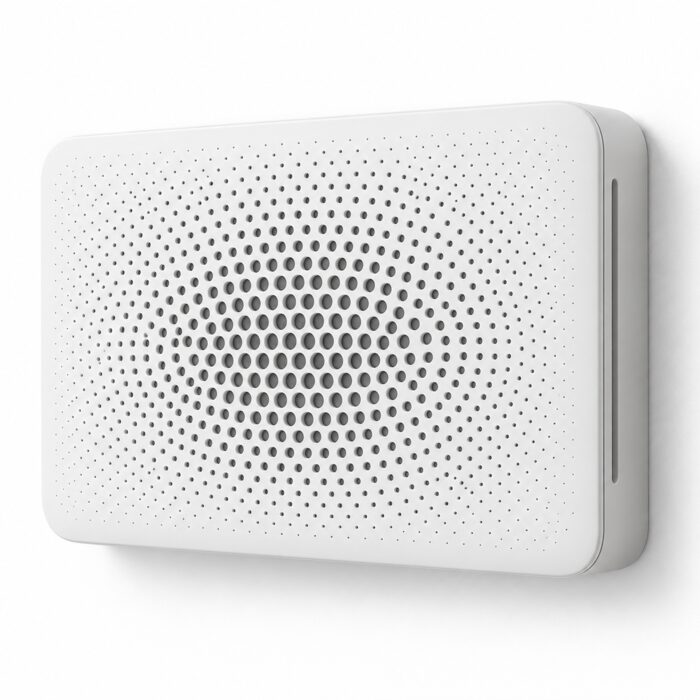
- A wall-mounted air filter in the room. A DC fan pulls the room's air through HEPA and activated carbon filters. It runs from a plug-in power supply, so there's no mains wiring inside the unit. An ESP32 on Wi-Fi reports its numbers to a server.
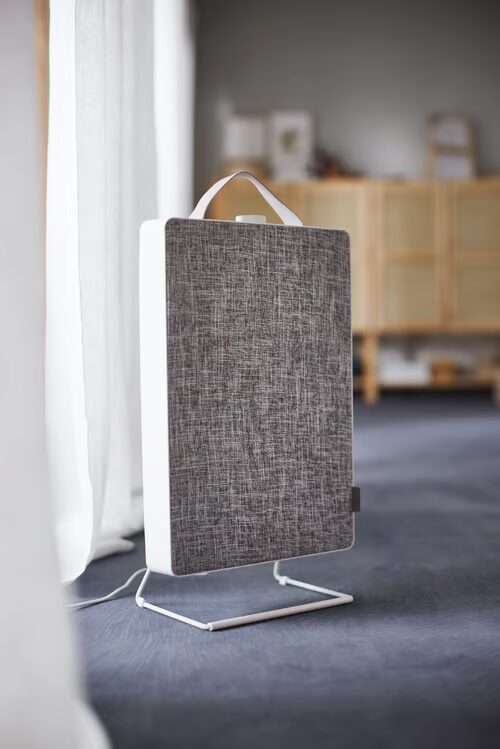
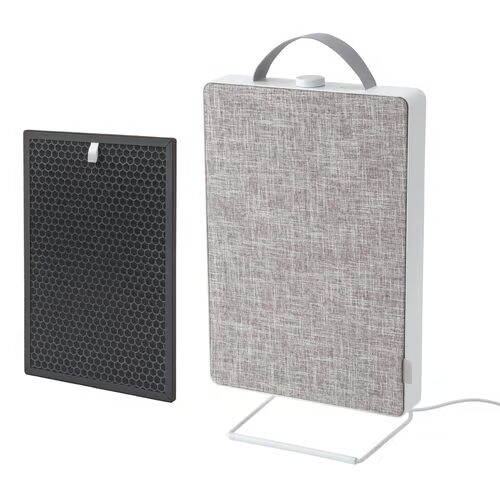
The shape comes from IKEA's FÖRNUFTIG air purifier: a slim panel with a fabric front that stands on a wire foot or hangs on the wall. It takes a particle filter, and an additional gas filter (the black honeycomb, bottom right) for smells. I could buy one. I'd rather make my own, and the philosophy page says why.
What the filters do
The two filters do different jobs. HEPA catches particles, such as litter dust and dander. Activated carbon adsorbs gases, and that's where the smell is.
I also want to try sending the air through a baffled section, folded back and forth like intestines, so it spends longer in contact with the carbon. More contact time should mean more of the smell gets caught. Every turn adds resistance, though, so the fan has to push harder for the same airflow. It's an experiment, and the sensors should show whether it helps.
Based on my research, litter tray smell is mostly ammonia, from urine breaking down, plus some sulphur compounds. Plain activated carbon doesn't hold ammonia well. Carbon impregnated for ammonia, or a layer of zeolite, does better. Part of this project will therefore be research based, and I will use AI to do this and write about it here.
What it reports
The numbers are there to show whether it works. I want to see the air before and after a tray gets used, how fast it clears, and when the filters need changing. That means particles (PM2.5), a gas or VOC reading, temperature and humidity, and the fan speed. An ammonia reading would be the most useful of all, if I can find a sensor that's worth having.
What I don't know yet
- The room's volume, and so how much air the fan has to move. I'll measure it.
- The filter sizes, and the order they sit in.
- Whether the carbon will deal with the ammonia, or needs an impregnated or zeolite layer.
- Whether the baffles help, and how much airflow they cost.
- A fan that pushes enough air through both filters and is still quiet.
- The sensors, and the server they report to.
- The cat flap, and what the door is made of.