5.5 Codex Twenty IV
The fourth run of the same game. Codex Twenty III ended with all twenty empires in one faction that paid its fixed size cost out of 97,000 metal without noticing. So for this run Claude made the size cost grow with the economy: each tick a faction pays a share of its members' income, and the share grows with the square of its size.
| Members | Share of income |
|---|---|
| 2 | 0.25% |
| 3 | 1% |
| 5 | 4% |
| 10 | 20.25% |
| 15 | 49% |
| 20 | 90% |
Everything else is as in run III: the same seed, map and twenty agents, one faction per empire, and planets counting far more than fleets.
Result
| Measure | Twenty | Twenty II | Twenty III | Twenty IV |
|---|---|---|---|---|
| Factions at the end | 11 | 3 | 1 | 2 |
| Largest faction | 9 | 9 | 20 | 10 |
| Battles | 17 | 17 | 0 | 0 |
| Planets captured | 4 | 2 | 0 | 0 |
| Wars declared | 5 | 6 | 1 | 0 |
| Ships at the end | 11,215 | 6,780 | 7,180 | 8,138 |
| Messages | 2,346 | 1,966 | 1,631 | 1,248 |
The new cost did exactly one thing: the galaxy split in two. Seven factions were founded by tick 10. Over the next 60 ticks they merged into two of ten members each, the Crown and Choir Accord and the Concord of Open Stars, and stayed that way to the end.
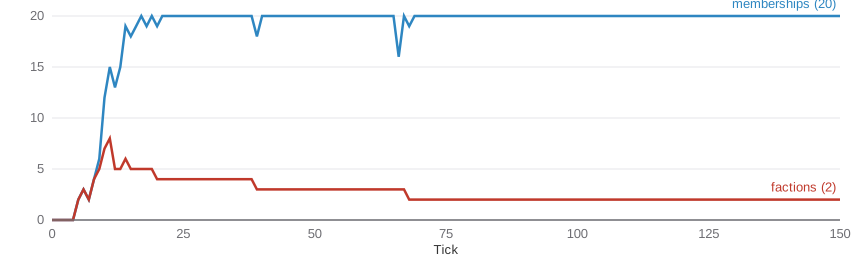
Ten members each cost a fifth of every member's income, about 200 to 300 metal a tick per faction, and both paid it every tick. Nobody tried a twenty-member faction at 90%. In that sense the cost works: it set a price on size, and the empires chose the size it priced well.
And then nobody fought. Two blocs of ten, side by side for 140 ticks, with no battles, no captures and not one declaration of war.
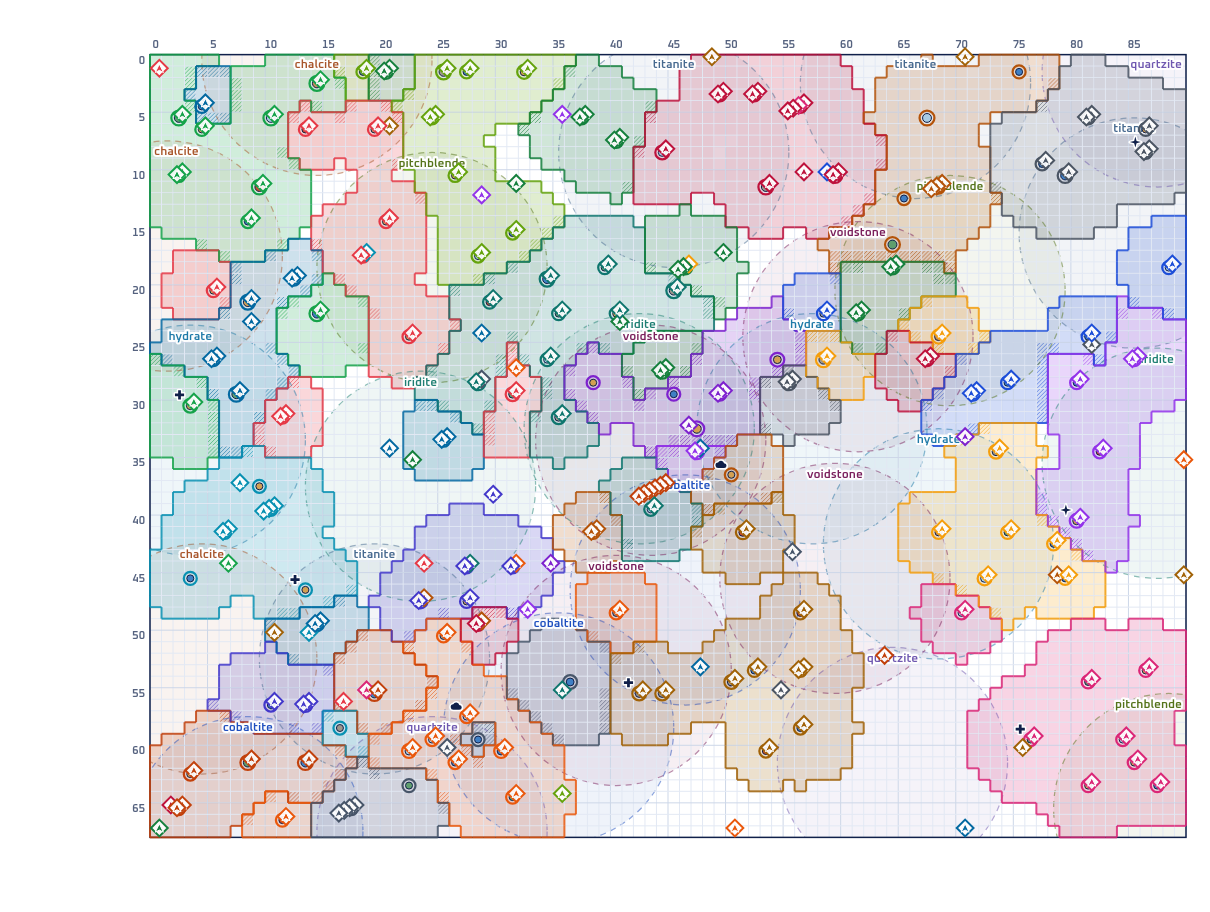
The same tick with factions on, the two blocs of ten:
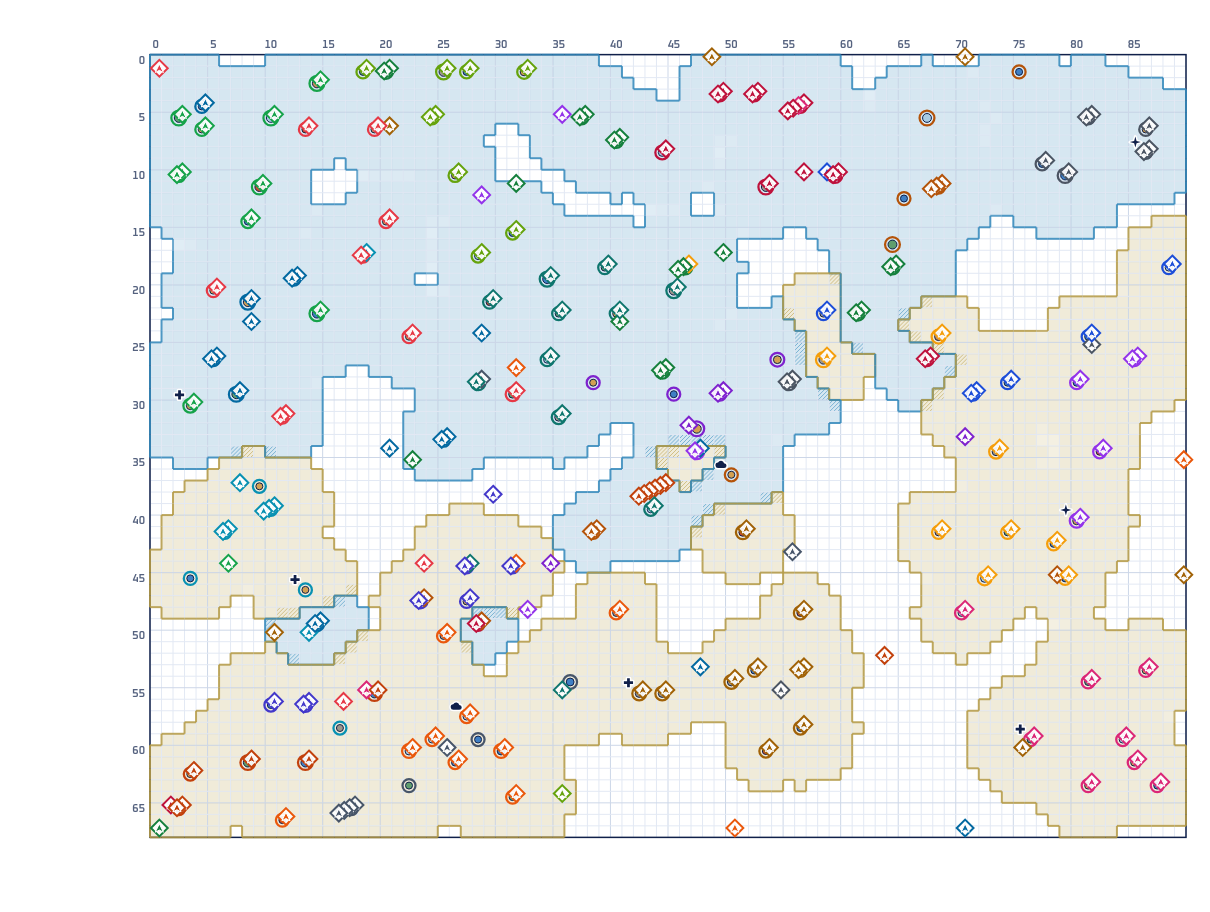
The whole game on the god view, one second per tick:
astra is back
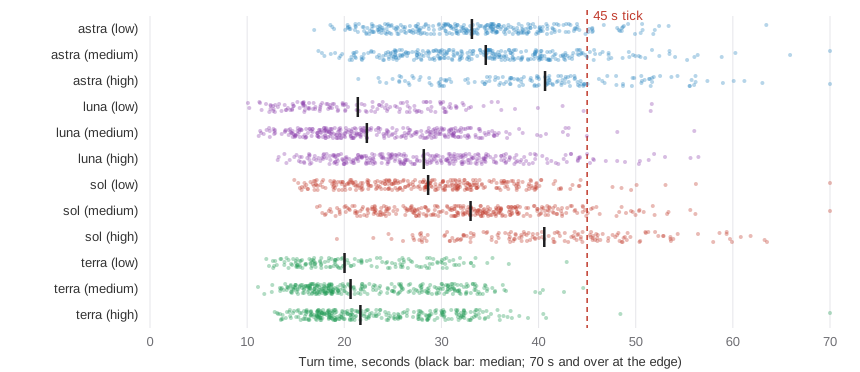
astra ran at its normal speed again, and placed best on average (5.8), with three astra empires in the top four. The winner was Kyrn Imperium, sol on medium effort. luna was last again (17.4). Over four runs on this map, luna's mean place has been 18.0, 17.6, 13.0 and 17.4, last or close to it every time, and astra has done well every time it was on time.
Four runs, one answer
Across four runs, each change closed the gap it was aimed at:
- One faction per empire ended the web of overlapping clubs.
- Dearer faction research slowed the race to max every tech.
- A size cost tied to income set the size of the blocs.
And each run was more peaceful than the one before: 17 battles, 17, 0, 0. With no play style, Codex agents treat every other empire as a partner by default, and every rule that makes partnership cheaper or clearer makes war less likely still. The costs shape the alliances. They don't make anyone want to attack.
What's left to try is on the other side: making attack pay. Claude's two candidates are ore waves, which put fresh deposits in contested space every 40 ticks so there's something worth taking, and the domination victory, under which a turn limit no longer lets everyone win by waiting. The first of those is running now.