5.3 B2, Blade Tower
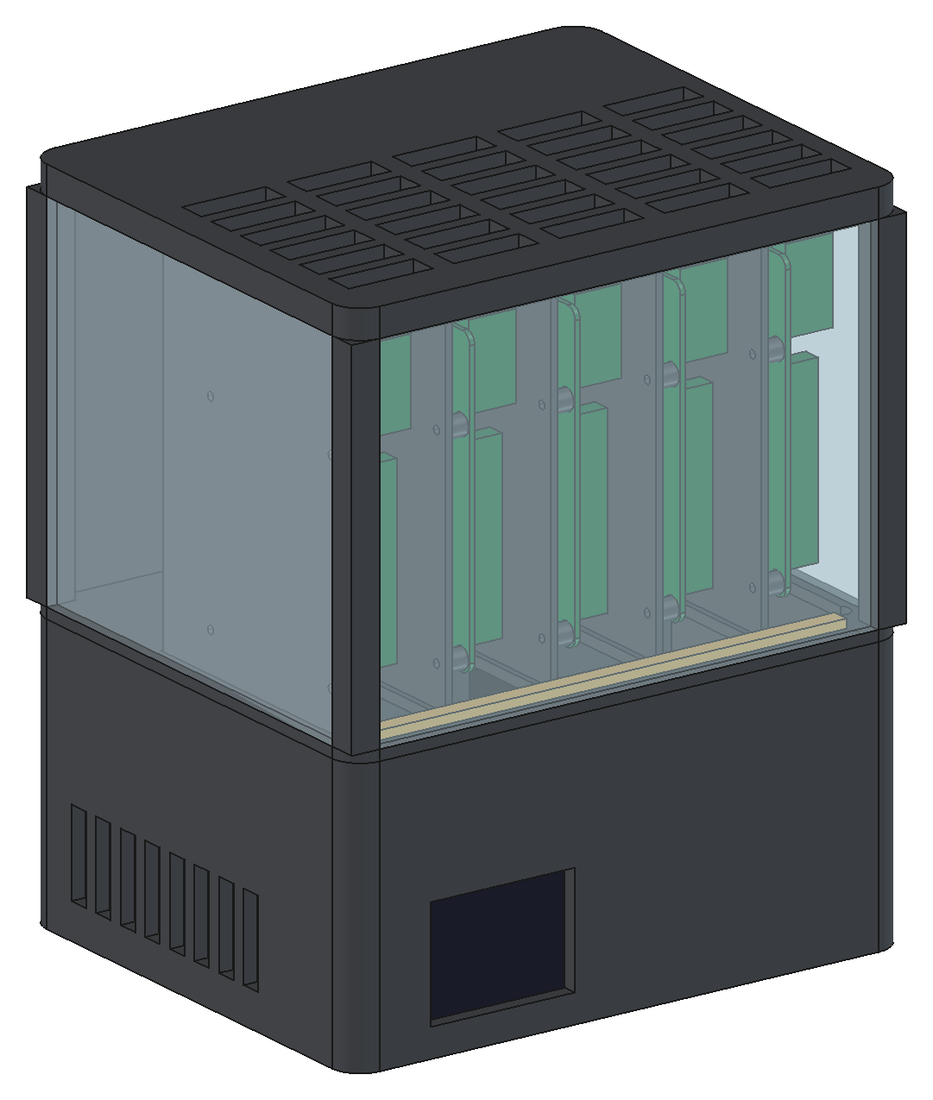
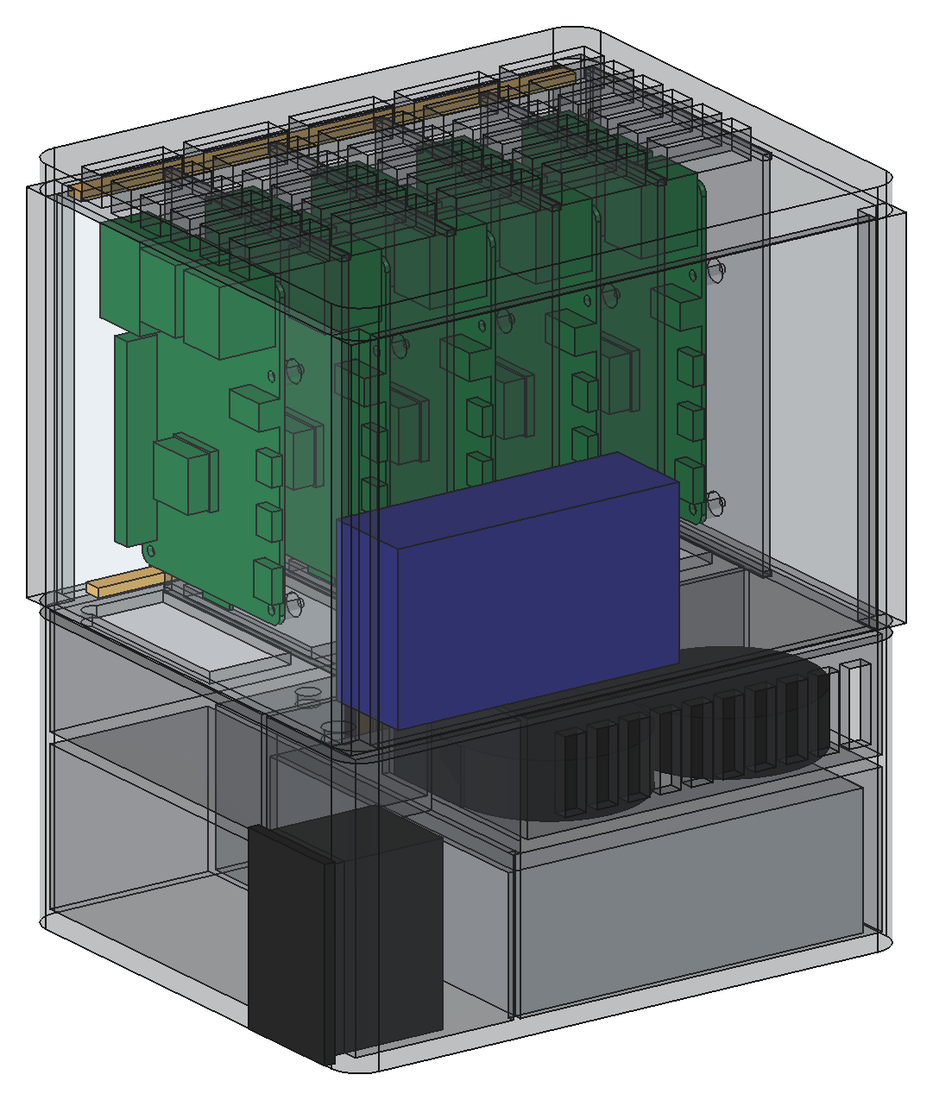
B (3.2) had the best air path and the worst stance: it was a cube. B2 stands the boards up. They're portrait now, 85 mm tall, so the whole thing is 158 × 132 × 190 mm, taller than it is wide.
The boards
Each board is still screwed to a blade, and the blades still slide into grooves in the deck and the top frame, 30 mm apart. What's changed is the way round:
- The board's long side is vertical, with the USB and Ethernet jacks at the top, under the grille.
- The USB-C edge faces the back, so the right-angle plugs point backwards into the space behind the boards, where the hub stands.
- The board is 56 mm deep instead of 85, so the cage is shallower.
Each channel is the 28 mm between two blades, 72 mm deep. Taking out the PCB and an 8 mm band of parts along it leaves about 1,490 mm², and at 0.4 L/s per board the air moves at about 0.27 m/s, up the board's whole face.
A new base
B's base had the blowers standing at the front and the power supply behind them. Standing the boards up made the cage shallower, so the base had to shrink to match, and that layout didn't fit any more. B2's base is new:
- The power supply lies flat at the front of the lower level, terminals to the right into the mains compartment, a 46 mm strip down the right side.
- The inlet stands upright in the right wall, at the back of that strip. Upright, its 47.5 mm length runs up the wall, and its body fits behind the terminal block instead of in front of it. The compartment rises into the upper level just there, to take the top of the inlet.
- The blowers lie on a shelf at the back of the upper level. They draw through ten slots in the back wall and blow forward under a baffle into the plenum, which fills the front of the upper level, right under the boards.
- Five slots in the deck, one under each channel, 52 mm deep, let the air up.
So the fresh air comes in at the back, turns under the boards and goes up past them and out of the top. The warm air leaves at the top, well away from the intake at the bottom of the back.
The screen
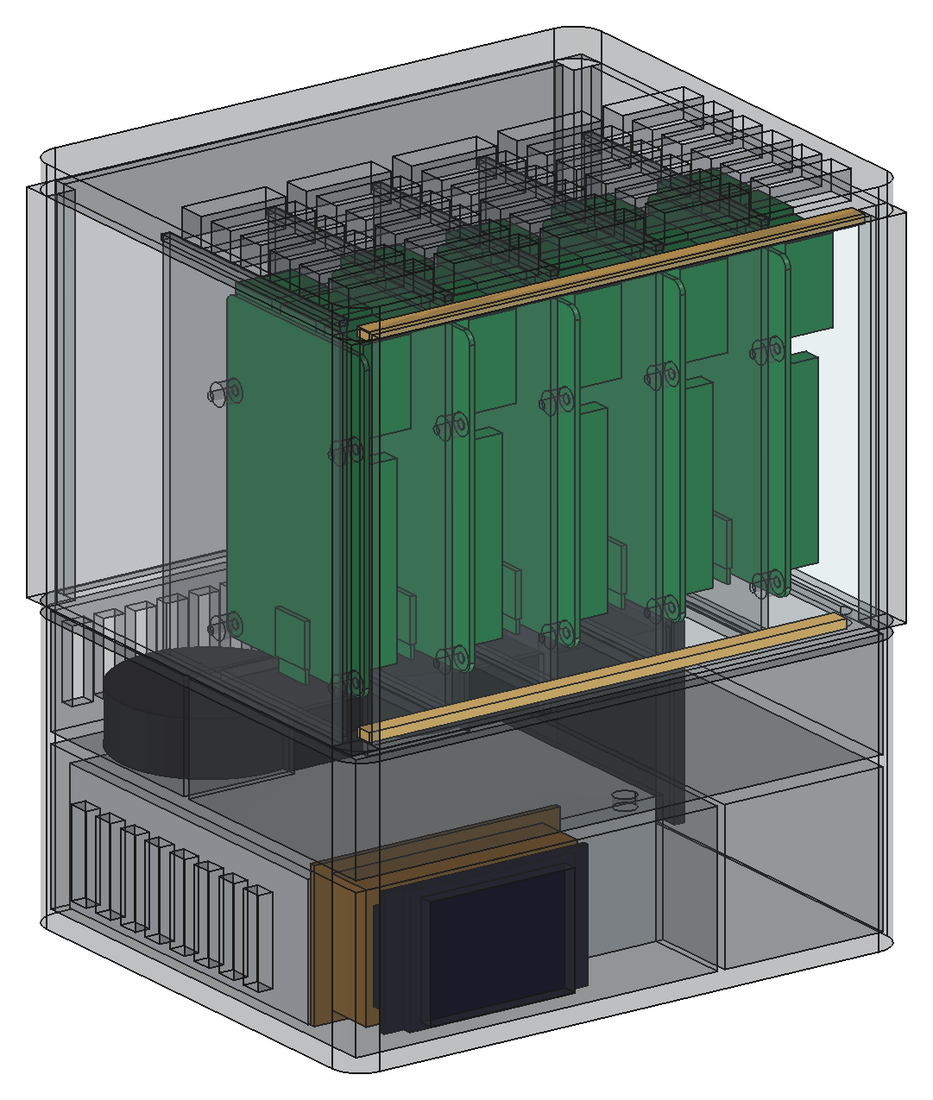
The LCD looks out of the base's front wall, low on the left, 6 to 41 mm off the desk, with the controller standing right behind it. They fit in the 25 mm between the front wall and the power supply. It's like the display on a hi-fi amplifier. The leads to the fans, the sensors, the lights and the INA226 go up through a hole in the shelf and another in the deck.
Lights
Two 5 mm WS2812B strips (the narrow 2020 type), about 140 mm each: one along the front of the deck shining up, one under the front of the top frame shining down. From the front I see five board edges with light running down the gaps between them.
The first check run caught both strips running 0.5 mm into the corner posts. They now start 4.5 mm in.
Checks
All pass, with no ballast.
| Check | B | B2 |
|---|---|---|
| Overall | 160 × 150 × 158 mm | 158 × 132 × 190 mm |
| Mass (estimate) | 1.37 kg | 1.46 kg |
| Tips at | 46° | 36° |
| Push at the top to tip it | 6.3 N | 4.75 N |
| Largest print | 160 × 150 × 91 mm | 158 × 132 × 110 mm |
Standing up costs some stability, as it should: the top is 32 mm higher and the base is 18 mm shallower. The nearest edge is 63.1 mm from the centre of gravity:
That's still more than A2, with no ballast.
What's left
- The boards' activity LEDs face sideways, not out of the front.
- The screen sits low. Raising it means finding the controller another home.
- No print is taller than 110 mm, so it's still the easier of the two to print.