3.2 B, Blade Rack
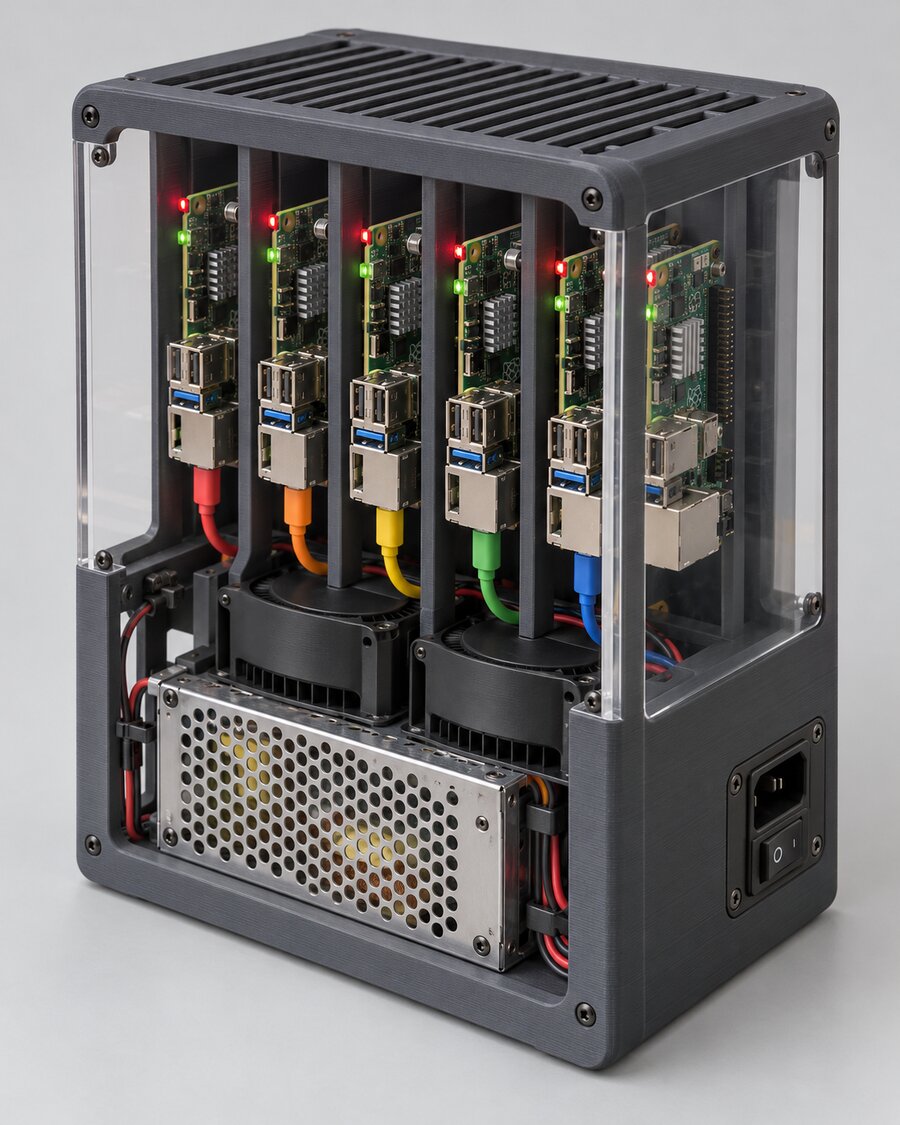
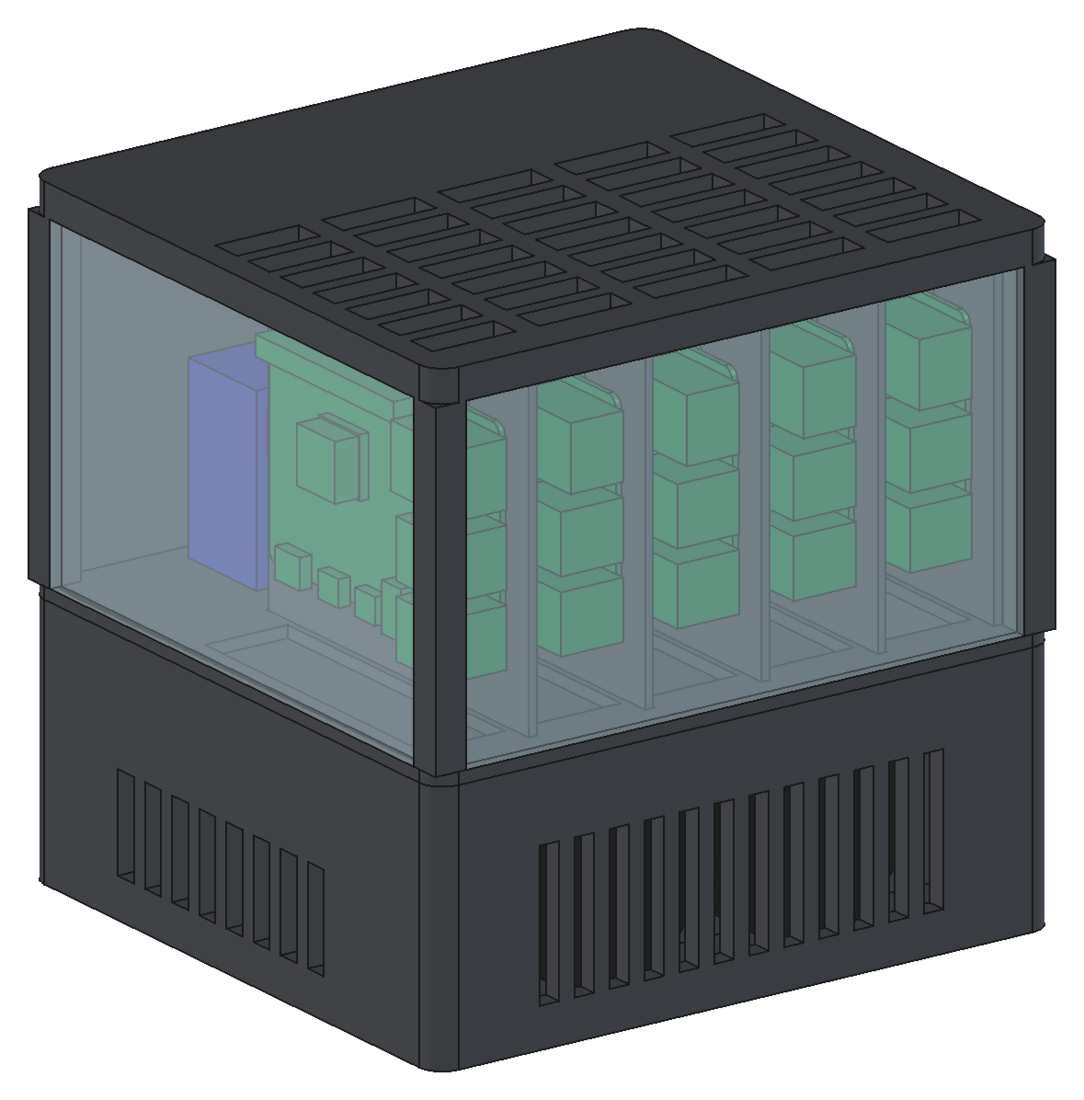
The five boards stand on edge, side by side, like blade servers. It's the smallest of the four at 160 × 150 × 158 mm, and it has the best air path, because the fans push the same way warm air wants to go anyway: up.
The base
The base is 64 mm tall, 150 × 140 mm inside, with 5 mm walls.
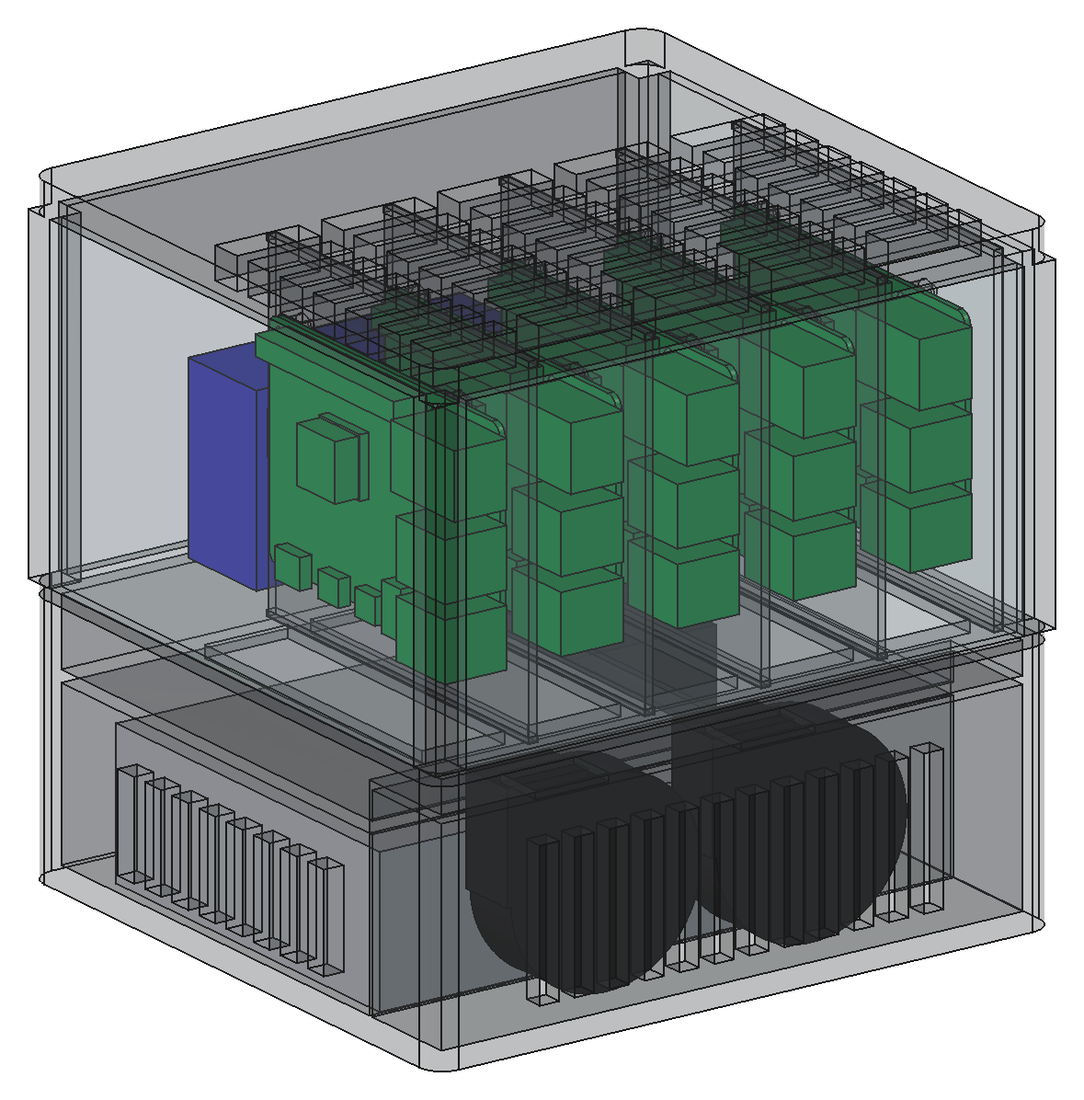
- The blowers stand upright at the front, side by side, 10 mm behind a grille in the front wall. Their inlets face the grille and their outlets point straight up.
- The power supply lies flat behind them, in its own chamber. A 1 mm wall at 25.5 mm from the front separates the two, and a 3 mm shelf at 44 mm closes the supply's chamber. It breathes through slots in the floor and the left wall.
- The terminals face right, into the mains compartment: the 46 mm strip down the right-hand side. The inlet is in the back wall of that strip. With the blowers at the front and the supply pushed back, the inlet's 47 mm depth fits behind the terminal block instead of on top of it.
- The plenum is the space between the shelf and the cage floor. A 2 mm plate over the blower bay at 54 mm has a 19 × 13 mm hole over each outlet, so the blowers fill the plenum and nothing else.
This layout is why B is shorter than A. A stacks the blowers over the power supply. B puts them in front of it.
The cage
Each board is screwed to a blade: a 2 mm printed wall with four 5 mm standoffs. The blades are 30 mm apart. The boards' components face left, the jacks face forward, and the USB-C edge is at the bottom, so the right-angle plugs hang 15 mm below the board, just over the floor.
The blades do two jobs. They hold the boards, and they wall off the air. Each board has its own channel between its blade and the next one: 28 mm wide and 96 mm deep, about 1,360 mm² once the board's parts are taken out. A slot in the deck under each channel lets the plenum's air in. It rises past the board and out through slots in the top frame. At 0.4 L/s per board, that's about 0.29 m/s, nearly twice A's speed.
The blades slide into 1.5 mm grooves in the deck and in the top frame, so a board comes out with its blade once the top is off.
The power hub stands on edge behind the boards, leads facing up, in the 40 mm of space between the blades and the back panel.
What the checks caught
B's first check run failed three ways:
- The inlet's body ran 1.5 mm into the wall behind the power supply (639 mm³). That wall moved 2 mm left.
- A short wall in front of the supply sat inside its lead space (144 mm³). It wasn't needed: the blower bay wall already closes that side.
- The fifth blade ran 0.4 mm into a corner post (66 mm³). The blades now start 4 mm behind the front instead of 1.
Perspex
Front and both sides, 144 × 83 mm and 134 × 83 mm, all 3 mm, sitting inside the four corner posts.
Printing
| Part | Prints | Size (mm) | Orientation |
|---|---|---|---|
| Base | 1 | 160 × 150 × 64 | Upright, open top |
| Deck | 1 | 160 × 150 × 3 | Flat |
| Frame (top and posts) | 1 | 160 × 150 × 91 | Top on the bed |
| Back | 1 | 144 × 83 × 3 | Flat |
| Blade | 5 | 96 × 86 × 7 | Flat, standoffs up |
No part is taller than 91 mm, and nothing needs support.
Balance
1.37 kg, centre of gravity 71 mm up, nearest edge 74.3 mm away. It tips at 46°, and the push at the top is:
Good and bad
- The best air path: up, the way convection goes, in parallel channels.
- Small, stable and quick to print.
- It isn't upright. It's a cube.
- From the front I see five board edges. Only the outer board shows its face, through the side.