6.8 Retro-futurism
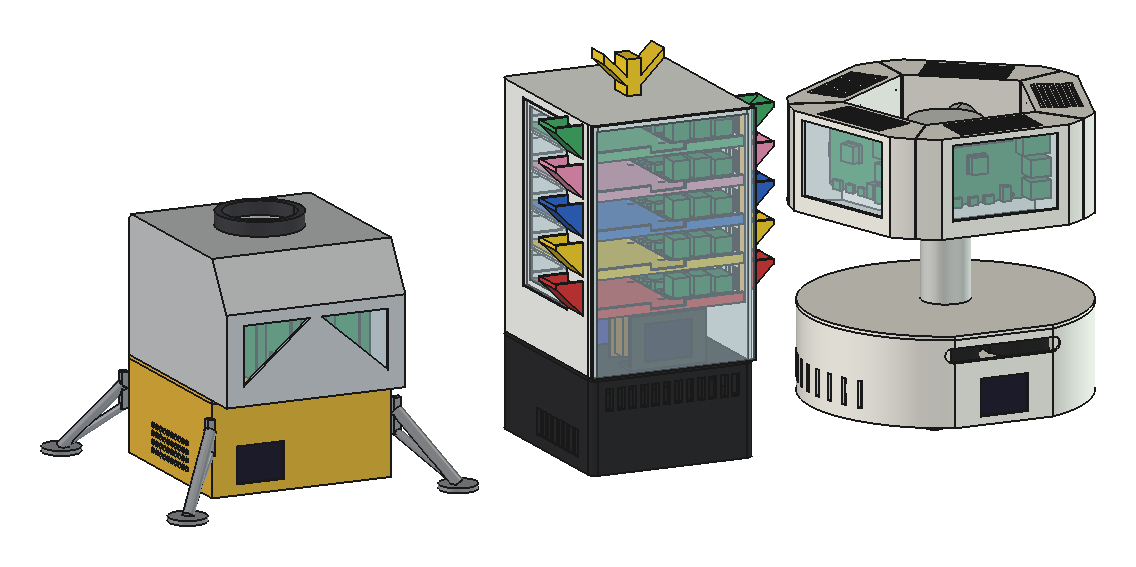
The last batch is the future as people used to imagine it: the space age of the late 1960s, and the early 1980s in Milan. A moon lander, a Memphis totem and a wheel in orbit.
F1 Lander
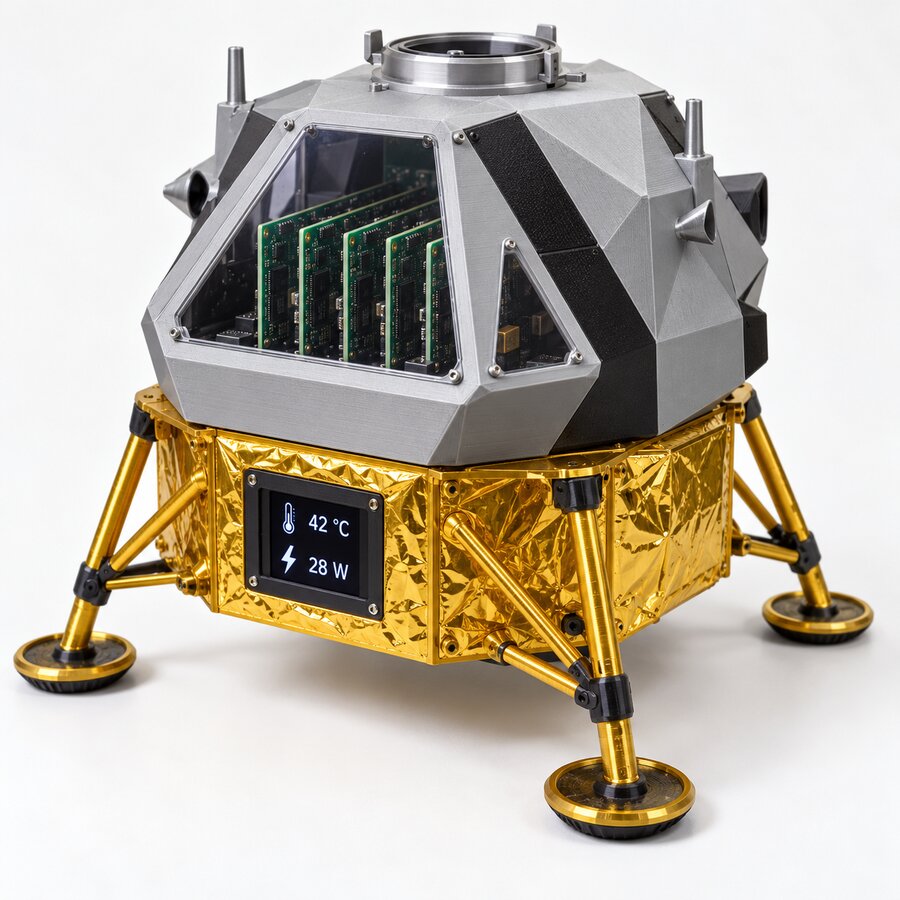
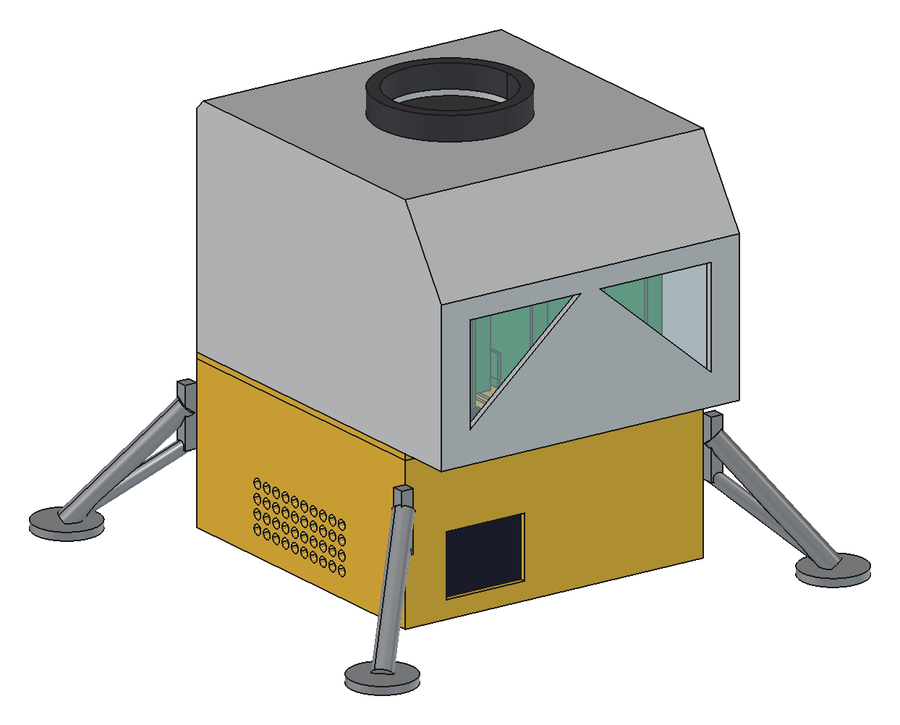
The Apollo Lunar Module came in two halves. The descent stage held the engine and the fuel and stayed on the Moon; the ascent stage held the crew and flew back up. It only ever flew in a vacuum, so it didn't need to be strong or smooth, and to save weight it was wrapped in thin gold-coloured insulation blankets instead of a hard shell.
The split maps straight onto the stack. The gold descent stage holds the power: the supply, the mains compartment, the blowers. The grey cabin holds the boards behind two triangular windows, and the round docking hatch on top is the exhaust. The four splayed legs are the feet, and they do a real job: with the pads 268 mm apart it's the steadiest upright design of all 32, with no ballast. The catch is that the cabin hides most of the boards, and you only see them through the two triangles.
F2 Totem
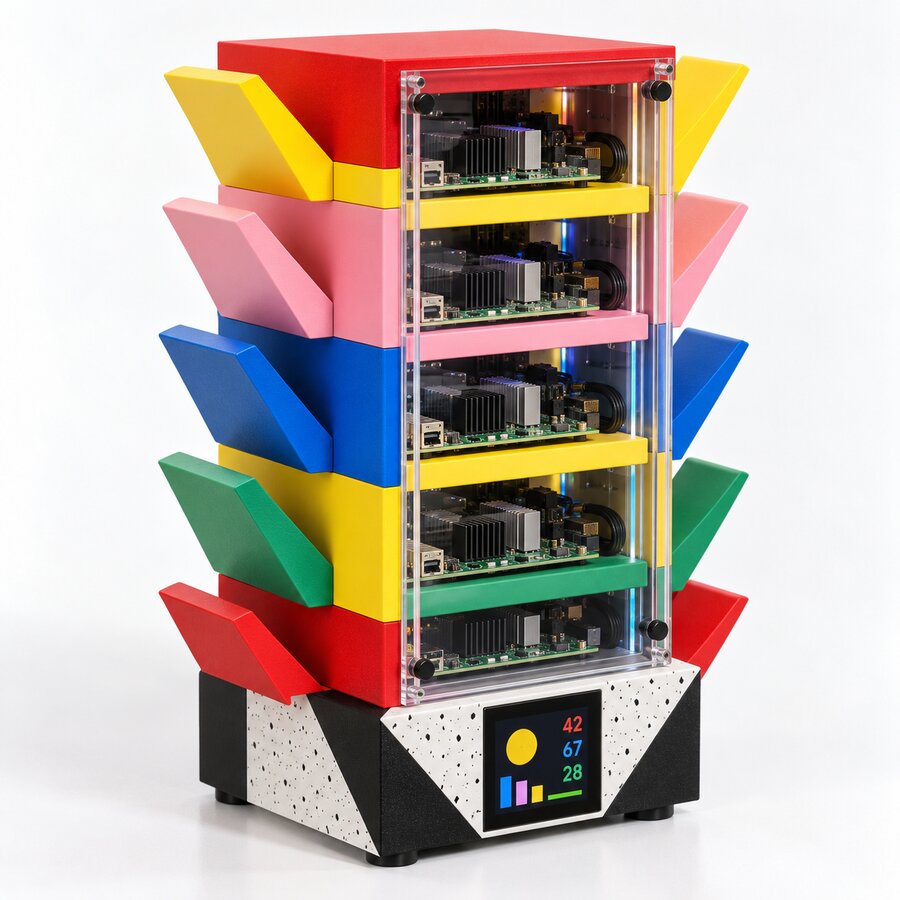
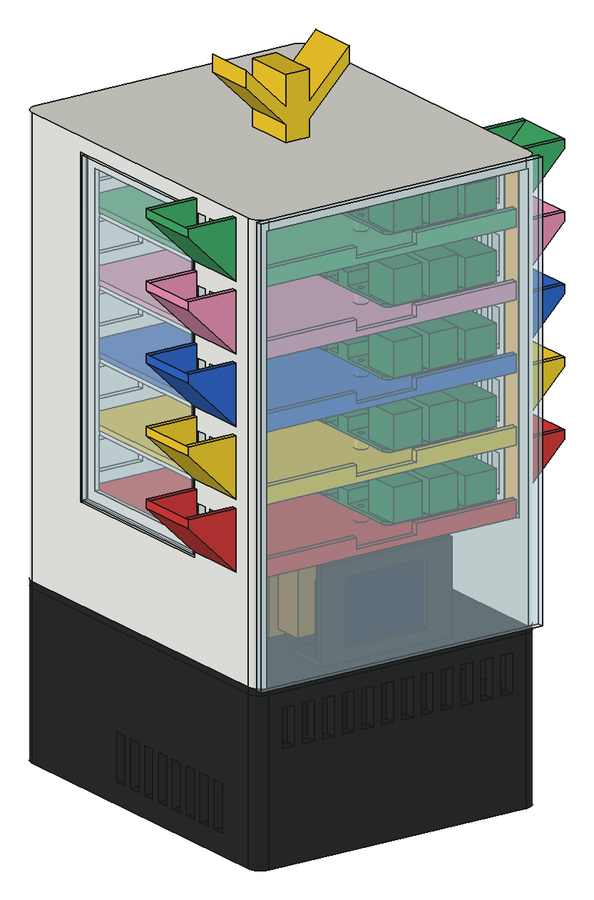
In 1981 Ettore Sottsass showed the Carlton bookcase at the first Memphis show in Milan: a two-metre room divider in plastic laminate, an upright with shelves sticking out at angles, in colours that clash on purpose. Memphis was a reaction against tasteful design, and the decoration was the point.
F2 is A2 dressed as Carlton. Every level gets its own colour, red, yellow, blue, pink and green from the bottom up, and Claude made the colour mean something: it's the node's identity, so the LCD and the lights show each board in its level's colour. The fins do a job too. Each one sits under its level's exhaust slots and leans out at 45 degrees, so the warm air coming out of the sides gets turned up and away from the intake in the plinth. ChatGPT made the whole tower out of coloured blocks; the model keeps the tower as one white print and puts the colour in the trays and fins.
F3 Station
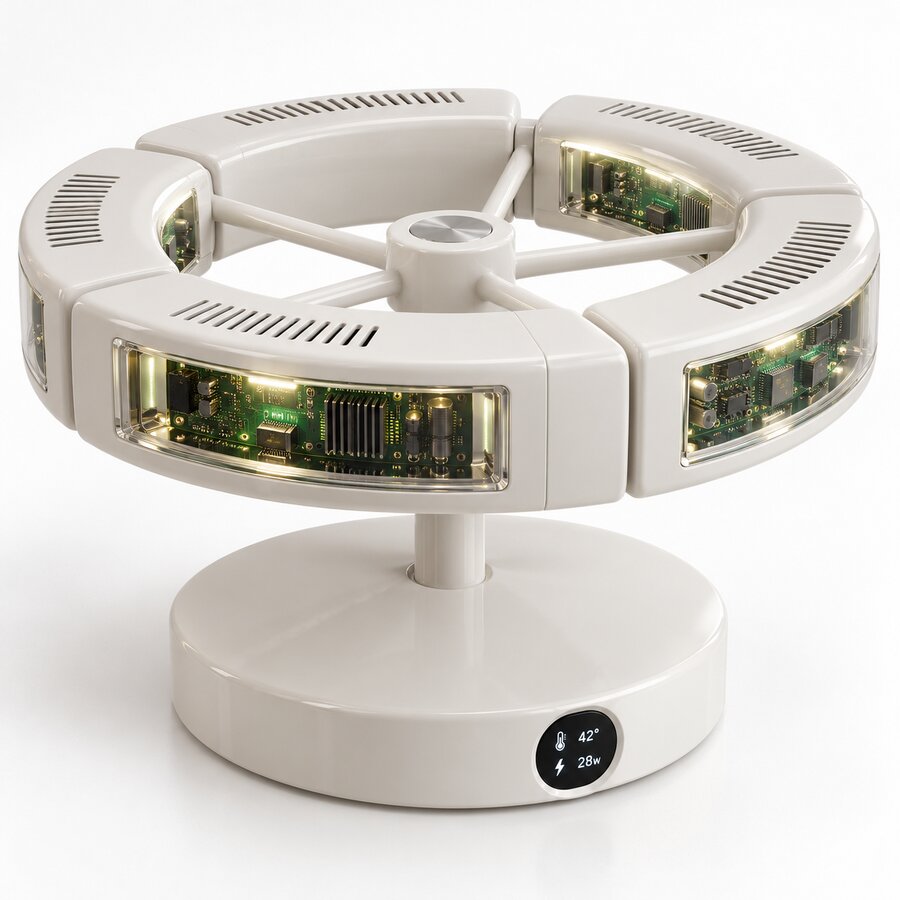
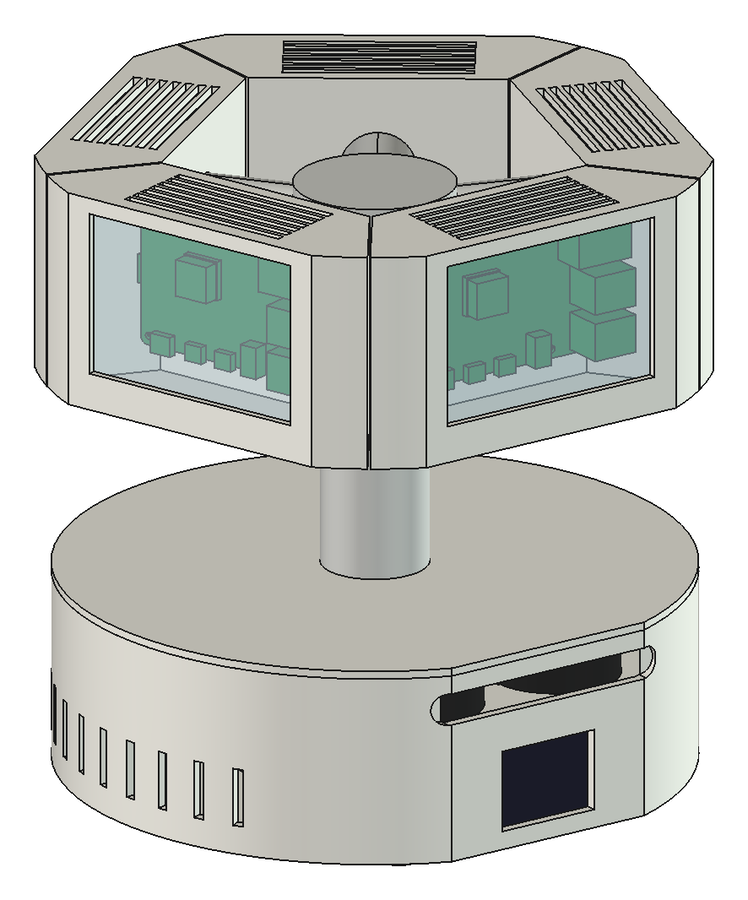
The space station in 2001: A Space Odyssey is a wheel turning on a hub, with spokes carrying people out to the rim. Add the JVC Videosphere, the TV shaped like an astronaut's helmet, and you have the white, round look of the late sixties.
F3 is a wheel of five modules, one board in each behind its own window, on a spindle above E3's round base. The spokes aren't decoration: the blowers in the base push air up the hollow spindle into the hub, and five tube spokes carry it out to the back of each module, so every board gets its own supply. It shows all five boards face on. The weak spots are the air, which comes in at one point behind each board and moves slowly, and the joints holding the wheel together, which aren't designed yet.
The numbers
| F1 | F2 | F3 | |
|---|---|---|---|
| After | Apollo Lunar Module | Sottsass's Carlton | 2001's space station |
| Size, W × D × H (mm) | 268 × 268 × 212 | 190 × 171 × 323 | 247 × 237 × 242 |
| Boards seen | Through two triangles | All five, through the door | Face on, one per window |
| Push at the top to tip it | 7.6 N | 4.2 N | 5.5 N |
| Mass, of which printed | 1.47, 0.53 kg | 1.95, 0.83 kg | 1.81, 0.77 kg |
Claude's pick is F2. That's the five batches done, and 32 designs to choose from.