6.7 Nature
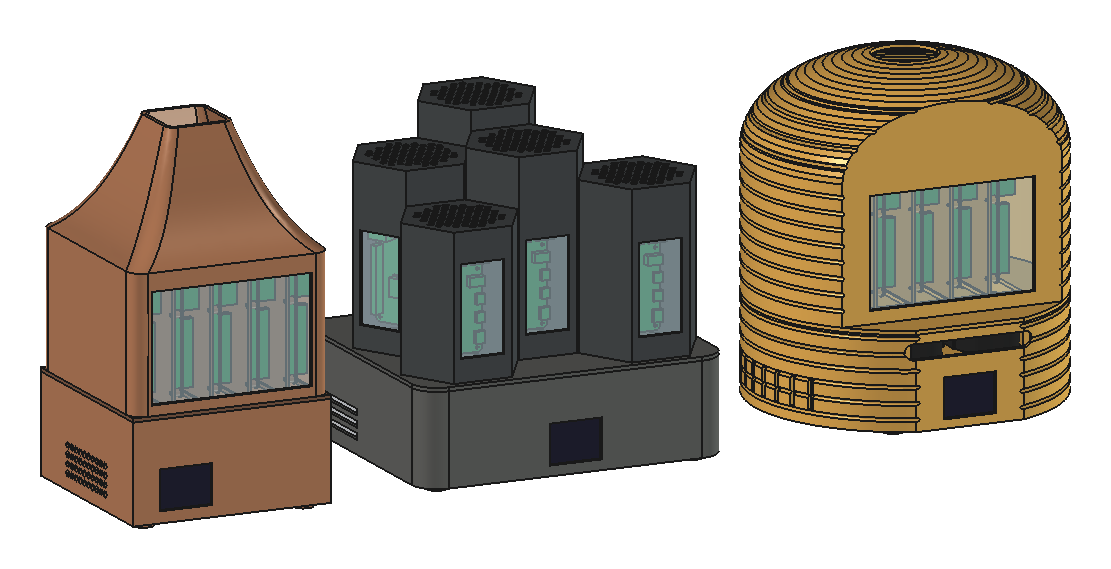
Batch four goes to nature: things that move air, or were made by heat. Claude started with a nautilus shell and dropped it after doing the sums: its chambers grow along a spiral, and a spiral whose smallest chamber can hold a Pi would be over 400 mm across. The three that worked are below.
E1 Mound
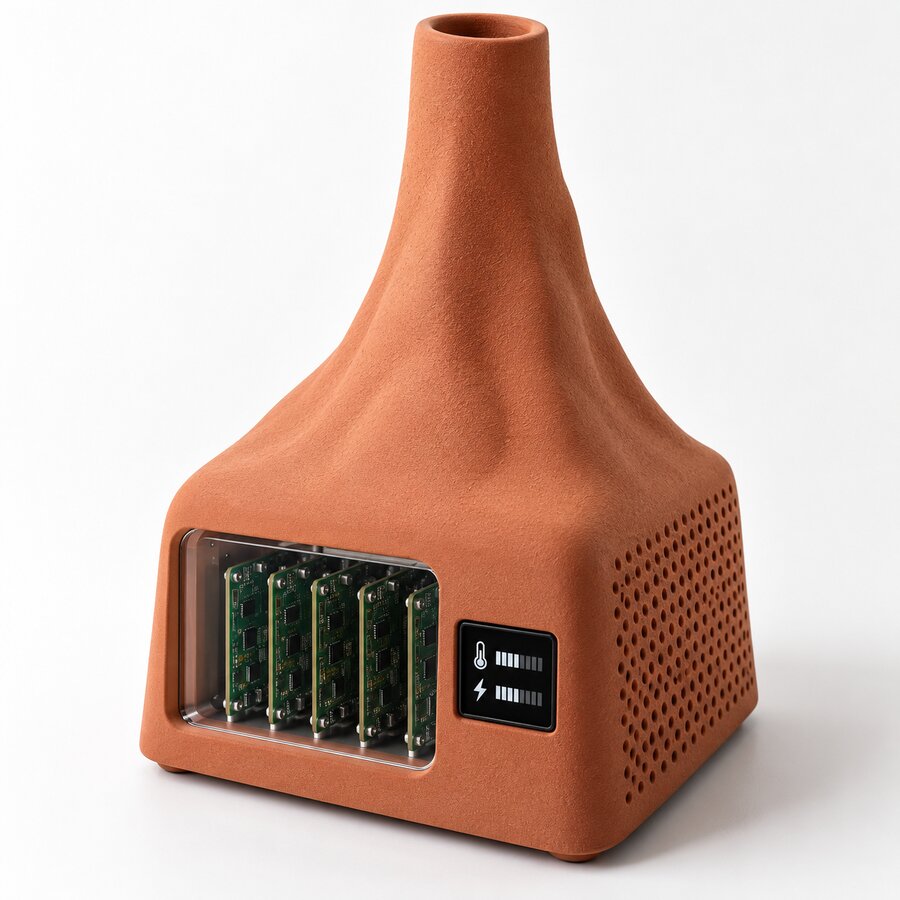
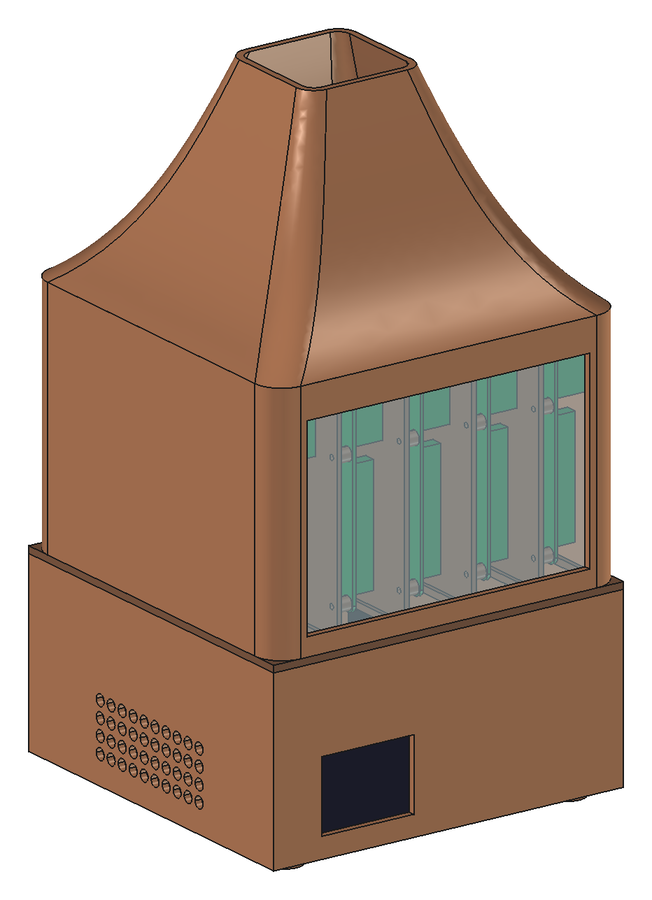
Termite mounds are famous for cooling themselves. The old idea was a chimney: warm air rises out of the top and pulls fresh air in. Mick Pearce built the Eastgate Centre in Harare on that idea. The newer research, by Scott Turner, says mounds actually breathe in and out through tiny pores in the walls, more like a lung than a chimney.
E1 is B2's inside under a terracotta mound that flares up into a chimney. The intake is a field of 3 mm pores in the back. Claude was honest about the chimney: 13 degrees of warming over 0.2 m gives about 0.1 pascals of draught, which is nothing next to the blowers. What it does do is keep air moving up past the boards if both blowers die. The flare is kept to 45 degrees so it prints without supports.
E2 Causeway
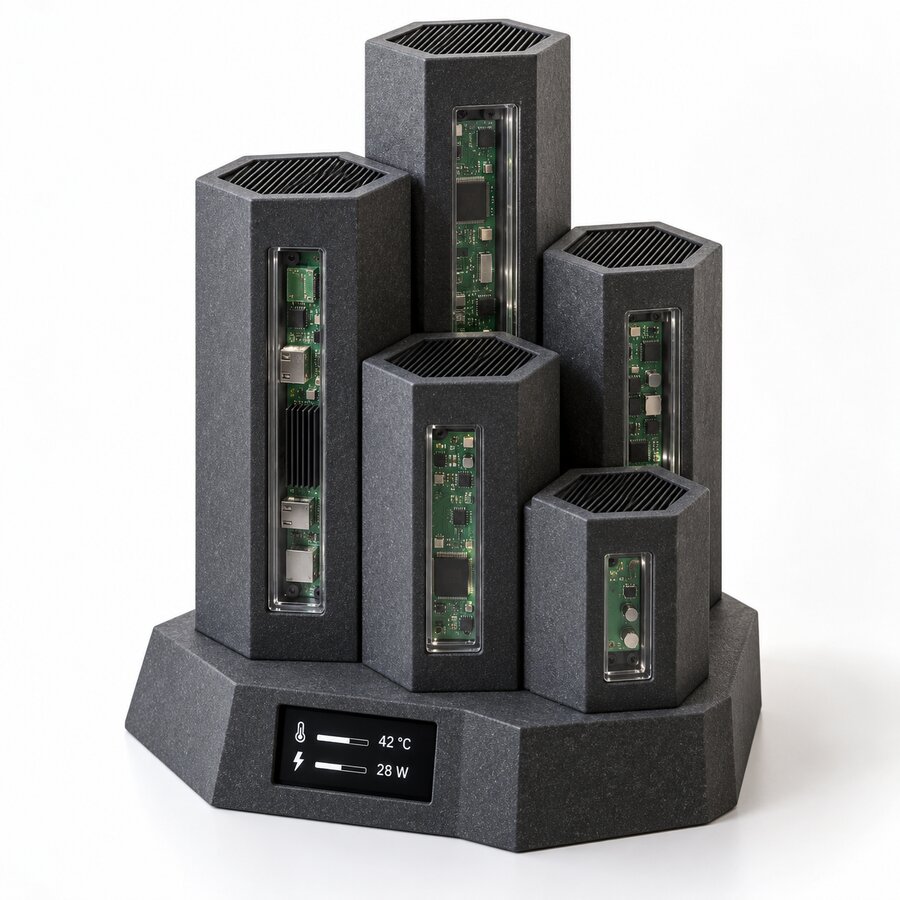
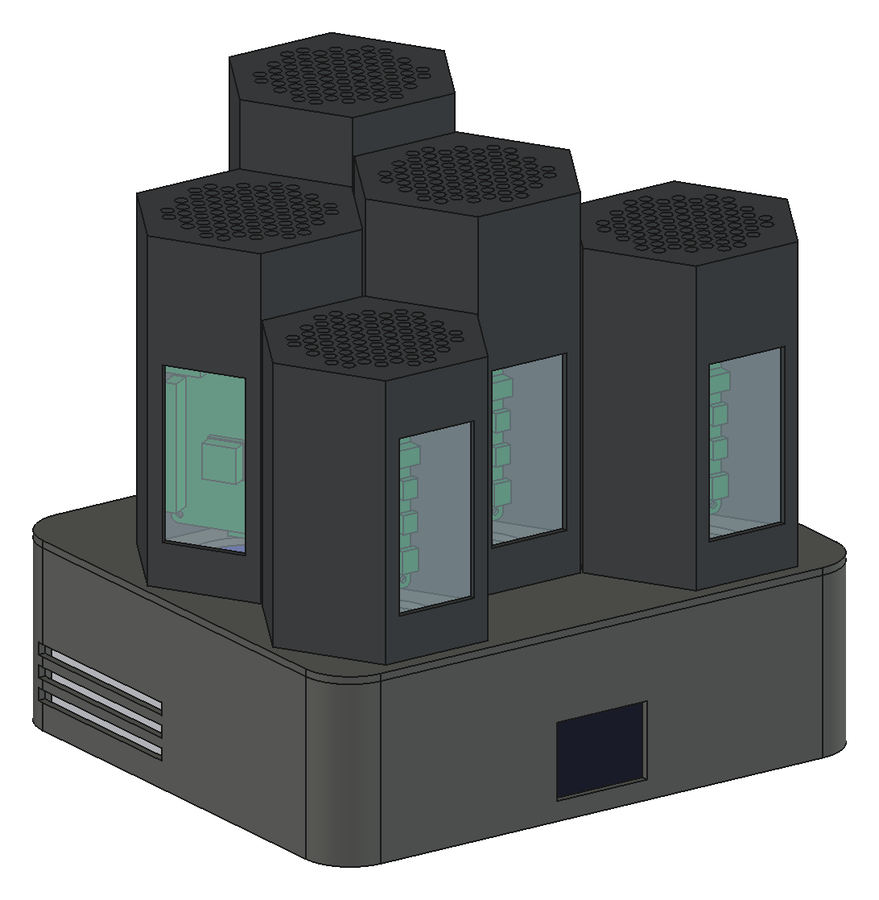
The Giant's Causeway is about 40,000 basalt columns, mostly hexagons, made when a thick lava flow cooled and cracked about 60 million years ago.
E2 is five hexagonal columns, 80 mm across, packed like a honeycomb at five different heights, one board standing in each behind a window. Each column is its own chimney straight off the plenum, so they're all in parallel. A board and its USB-C plug need 70 mm across the column, and the hexagon gives 75 at the right depth, which is why it's 80 mm and not smaller. It's the steadiest of the three, but each window only shows a strip of its board.
E3 Skep
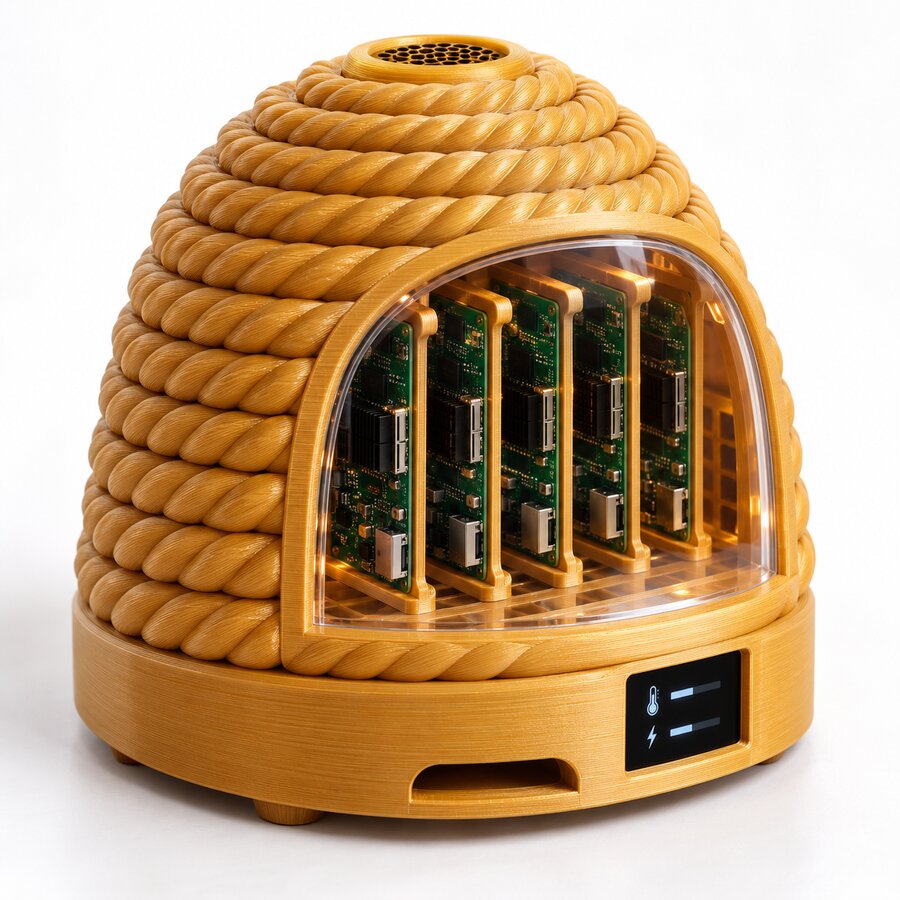
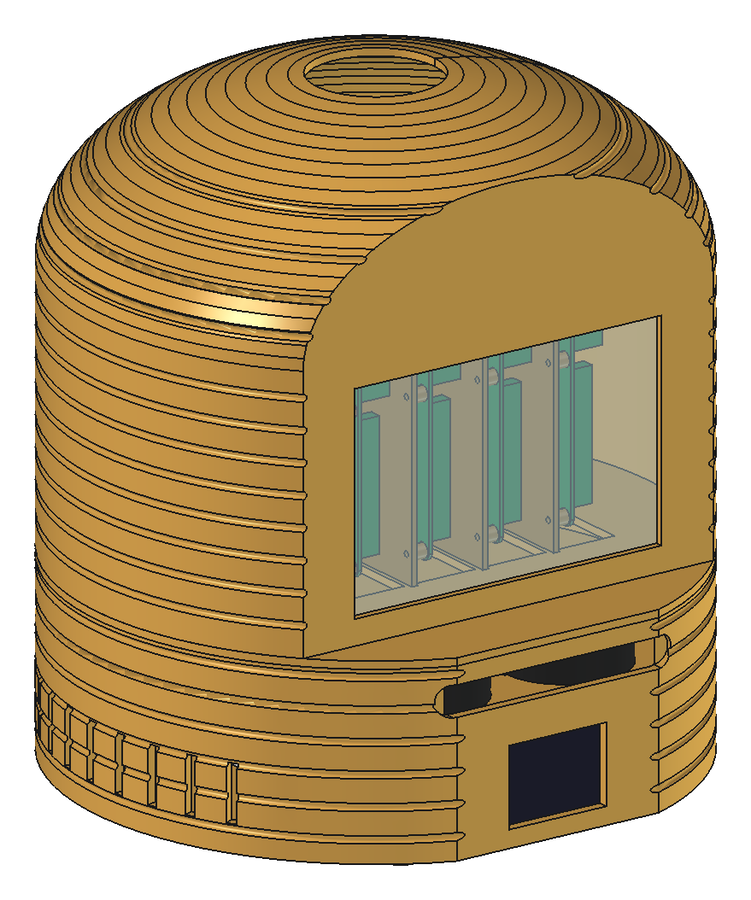
The beehive maps onto the layout closely. A skep is the old straw beehive, a rope coiled into a dome with one entrance low down. In 1851 Lorenzo Langstroth worked out the "bee space": bees leave a gap of 6 to 9 mm between combs, so frames hung at that spacing can be lifted out. And bees cool the hive by fanning at the entrance.
B2's boards already hang in parallel with a gap between them, like frames. So E3 is H1's round bench with the blowers right behind a wide entrance slot in the front, B2's five blades on the deck, and a honey-gold dome of coiled rings over them with a vent at the crown. The catch is the printing: the dome's crown is too flat to print without support, so it needs splitting or a pointier top, which would be closer to ChatGPT's.
The numbers
| E1 | E2 | E3 | |
|---|---|---|---|
| After | Termite mound | Giant's Causeway | Beehive skep |
| Size, W × D × H (mm) | 156 × 156 × 280 | 240 × 210 × 244 | 236 × 228 × 253 |
| Boards seen | On edge, through a window | A strip through each column | On edge, through the dome's window |
| Push at the top to tip it | 3.0 N | 5.1 N | 5.0 N |
| Mass, of which printed | 1.47, 0.51 kg | 1.74, 0.76 kg | 1.68, 0.72 kg |
Claude's pick is E3. Twenty-nine designs now, one batch to go.