4.1 Round 1: Swoop, Hook and Rails
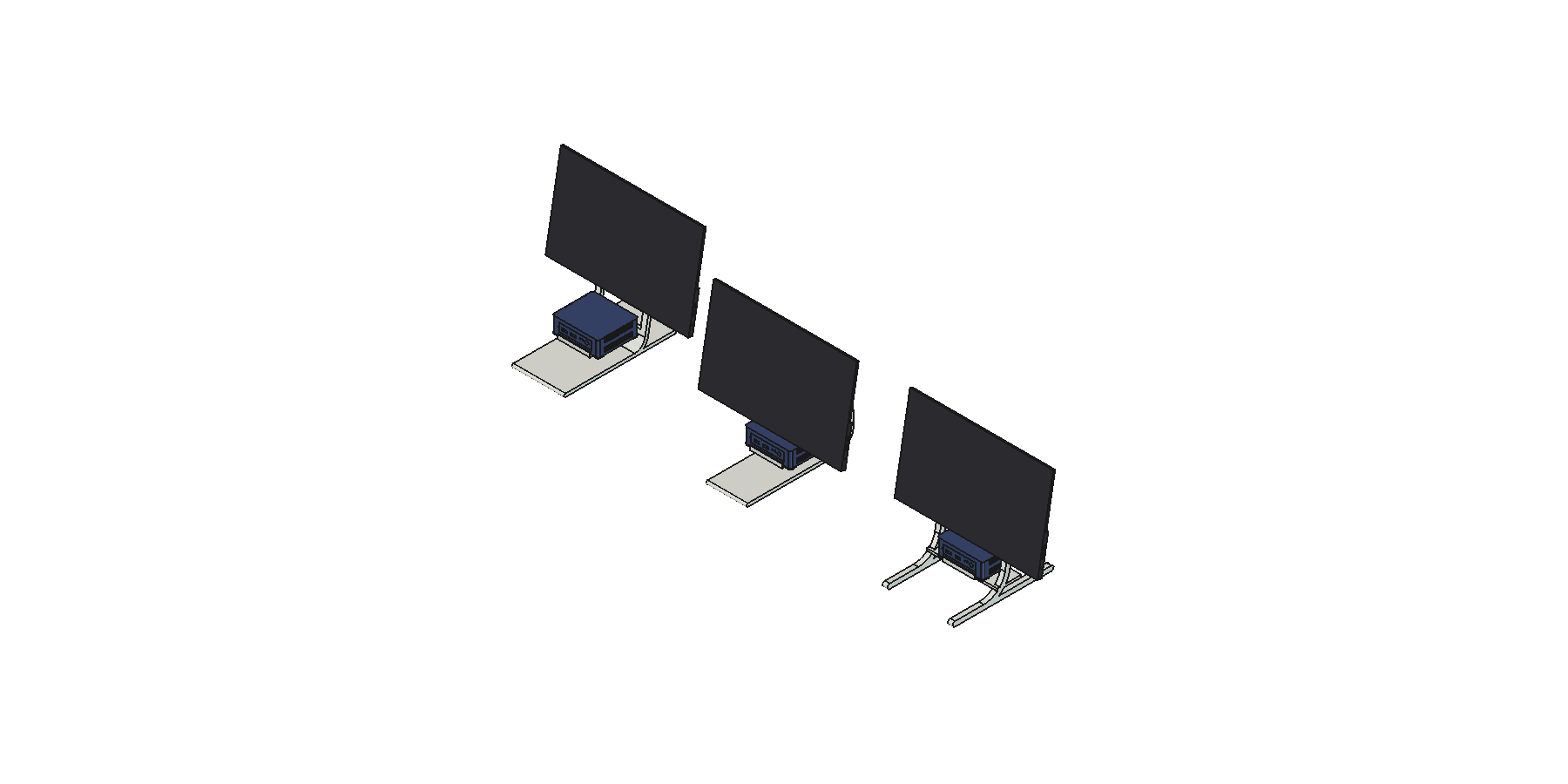
| A Swoop | B Hook | C Rails | |
|---|---|---|---|
| Form | One 130 mm band, 8 mm thick: a foot with a heel and an arm leaning back 10° | One 100 mm band in a "?" profile: the arm rises behind the PC and curls forward to the screen | Two 12 × 12 mm runners past the PC's sides to a crossbar behind the screen |
| Screen relative to the PC | Behind it: the PC's front is 105 mm ahead | Directly above it | Above it, 16 mm behind its front |
| Cables | Through a window in the arm, as on an iMac | Into the open loop behind the PC | Out of the open frame |
| Push at the screen's top that tips it: forward, back, sideways | 8.1, 3.6, 2.7 N | 5.7, 3.7, 2.1 N | 5.4, 4.0, 3.4 N |
The stand that fell over on its own
Concept A's first version had no heel. The screen leans back on the arm, and that put the centre of gravity 6 mm behind the foot. The model tipped over backwards with no push at all. The fix was a heel 70 mm behind the arm.
That is the first balance lesson: a screen that leans back moves the centre of gravity behind its support. Check balance with real masses, not only fit.
The choice
- A reads most like an iMac, but the PC sits in front of the screen like a plinth.
- B stacks the screen over the PC and leaves an open loop for cables. Its band is 268 mm long, more than the A1's 256 mm, so it would need a split.
- C is the lightest and the steadiest sideways, but the runners look like skis.
I chose B.
A note on these numbers
All three pass the usual display test: the centre of gravity stays over the footprint when tilted 10° any way. But a push of 2 to 8 N at the top of the screen tips them, and a light push with one finger is 5 to 10 N. A PLA stand is light, and a 357 mm screen is wide against a 100 to 130 mm band. Widening the foot raises the sideways figure in step with its half-width. Ballast low down adds mass.