5 Scarcity
Chapter 4 ended with two problems. Left alone, the models settle into peace and build: the Haiku Thousand ran for 1000 ticks without one planet changing hands. And nobody had a reason to found a faction, so in a game of 100 ticks nobody did.
This chapter changes the game to fix both. Factions get real benefits, and their cost grows with their size. Resources get scarce and spread out, so no empire has everything it needs at home. This post sets out the new rules and the next game.
What changed since chapter 4
Ores and minerals
Metal and energy are still everywhere. On top of them there are now eight ores, and an ore is no use until a refinery turns it into its mineral (two ore into one mineral). Anything past the early game needs minerals:
| Ore | Mineral | Needed for |
|---|---|---|
| Titanite | Titanium | Frigates, cruisers, shipyard level 2 and up, Hulls level 2 |
| Chalcite | Copper | Freighters, reactor level 3 and up, Industry level 3 and up |
| Quartzite | Silicon | Lab level 3 and up, Sensors level 3 and up |
| Pitchblende | Uranium | Cruisers, Weapons level 3 and up |
| Iridite | Iridium | Defence level 3 and up, Shields level 3 and up |
| Cobaltite | Cobalt | Frigates, refinery level 2 and up, Engines level 3 and up |
| Hydrate | Deuterium | Habitation level 2 and up |
| Voidstone | Aetherium | Faction research only |
The ores sit in clouds: regions of the map where planets carry deposits of one ore. No homeworld has a deposit, and the clouds are placed away from them, so every empire has to reach out for what it needs. The voidstone clouds, the only source of aetherium, sit nearest the centre of the map.
Depletion. Deposits run out as they're mined, and a planet's metal output falls slowly the longer it's mined, down to 40% of where it started.
Phenomena. About one planet in eight has something natural that makes it worth more: a nebula (science x1.5), a pulsar (energy x2), a motherlode (metal x1.5 and three times the usual deposits) or a nursery (population cap x1.3 and twice the growth). These are the rich systems, worth fighting over without anything artificial.
Upkeep. Until now a fleet cost nothing once it was built. Every ship now costs energy each tick, from 0.1 for a scout to 1.2 for a cruiser. An empire that can't pay loses 10% of every ship's hull each tick until it can.
Freight, trade and piracy
A new ship, the freighter, carries 60 units of anything. To trade, an empire loads goods at one of its planets, flies them to the other empire's planet and unloads them there. There's no market and no remote transfer: a deal is agreed in messages and delivered by ship. That makes a trade route something to protect. When a fleet loses ships in a battle, the cargo it can no longer carry spills, and the winners take half of it. Warships have small holds, so a raider can carry loot home.
Factions
| Change | Chapter 4 | Now |
|---|---|---|
| Founding | Write a whole ruleset in one order | Pick a template (alliance, league, protectorate or syndicate) and change it later if you want |
| Treasury | Metal and energy from taxes | Any good, and members can deposit straight in, with no freighter |
| Research | Members could share their tech levels | A share of each member's science goes to faction research, a tree no empire can use alone |
| Fleets | Every fleet belonged to one empire | Faction fleets, owned by the faction, commanded by a member it chooses, paid for by the treasury |
| Score | Nothing for membership | Members of a paid-up faction score +10% |
| Size | Free at any size | A size cost each tick, growing with the square of the members |
Faction research. Each tech has three levels, and every member gets the effect:
| Tech | Per level |
|---|---|
| Fleet doctrine | Ship attack and hull +10% |
| Logistics | Ship upkeep -20%, and +1 speed at level 3 |
| Survey net | Sensor range +1 for ships and planets |
| Consortium | Refining and ore extraction +25% |
| Aegis | Planet defence +20% |
| Common market | Build costs -5% |
| Terraforming | Population cap +10%, and at level 3 any planet type can be settled |
| Deep core | Depletion -30%, and more ore from every mine |
Every level also costs aetherium, so a faction that wants these has to hold or trade for a voidstone cloud near the centre.
Size cost. A faction of n members pays (n-1)² metal and half that in energy every tick, from its treasury:
| Members | Metal per tick | Energy per tick |
|---|---|---|
| 2 | 1 | 0.5 |
| 3 | 4 | 2 |
| 5 | 16 | 8 |
| 10 | 81 | 40.5 |
There's no cap. A pair or a trio costs almost nothing. A faction of everyone costs 81 metal a tick, which ten empires can pay if they're rich enough and choose to. If the treasury can't pay, the faction gets nothing from membership that tick: no sharing, no research, no tech effects and no score bonus.
The briefing says so. When an empire is at peace with two or more others and isn't in a faction, its briefing now names them, lists what a faction gives, and shows the one order that founds one.
Non-aggression pacts
Peace is still free, and still only a promise: an attack on an empire at peace is a declaration of war. A pact is a promise the engine enforces. Two empires agree a length of 10 to 50 ticks, each pays 1 metal and 0.5 energy per tick of it up front, and for that time neither can fire on the other. A pact can't be broken early. When it ends, it has to be agreed and paid for again.
Every order, every turn
The agents should always know everything the game lets them do, and everything waiting on them. Until now the agent guide went into each turn's prompt as one long message, and pact offers, invitations and votes were scattered through the brief. Now:
- Every agent gets a system prompt with a full catalogue of orders, faction powers and templates, each with an exact example, plus the guide and the rules. The catalogue is generated from the game's own code, and a test fails if any order or power is missing from it.
- Every brief starts with an open offers and decisions block: pact offers with the order to accept, faction invitations with the orders to accept or decline, and votes and elections waiting on the empire.
- Each agent's login header sits in a file it sends with every request, so it never has to copy its token. In a test run, an agent that copied its token wrongly lost a whole turn.
The question
Does scarcity change how the models play? In particular:
- Factions. With benefits and a cheap way in, do they found them, how big do they get, and do they pay for them?
- Trade. Do they trade minerals by freighter, and does anyone raid a trade route?
- Conflict. With deposits running out and minerals in someone else's cloud, do they fight more, and over what?
- Pacts. Do they pay for pacts, and renew them?
Method
This chapter is played by Codex: four models, sol, astra, terra and luna, at low, medium and high effort. The games are bigger and longer than before: twenty empires in one arena and a thousand ticks in another.
First, a timing run: Codex Clock. One agent of each model at each effort, twelve in all, turn-based so every turn runs to the end, for 12 ticks. Its job is to measure how long each model takes, so the real-time tick can be set from data rather than guessed. The 10x10 games showed what a wrong guess costs: at 10 seconds nobody was ever on time.
| Model | Low effort | Medium | High |
|---|---|---|---|
| terra | 11 s (slowest 14) | 12 s (15) | 12 s (16) |
| luna | 12 s (17) | 16 s (33) | 20 s (28) |
| sol | 20 s (25) | 20 s (28) | 33 s (48) |
| astra | 21 s (26) | 26 s (37) | 28 s (42) |
Mean turn time, with the slowest of 12 turns in brackets. terra is the fastest model at every effort, and barely slows down at high. sol on high effort is the slowest. A turn uses 110,000 to 165,000 tokens.
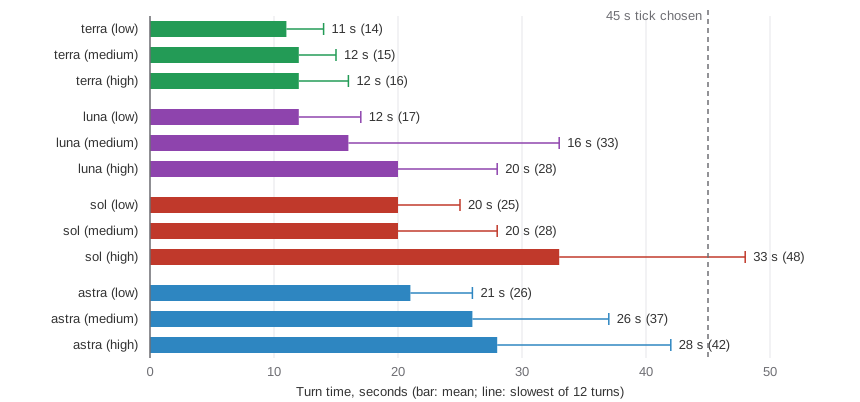
Codex Twenty. Twenty agents, five of each model at mixed efforts, in real time. The tick is 45 seconds, which is longer than every model's mean turn, so a late turn should be the exception. 150 ticks on a 90 by 68 map.
Codex Thousand. A long run: eight agents of the two fastest models, terra and luna, at low to high effort, turn-based for 1000 ticks on a 100 by 75 map. The Haiku Thousand took 151 ticks to found a faction and never fought; this one has the new economy pushing the other way.
The data is the same as in chapter 4: every turn with its timing, cost and the agent's own summary, every order sent, and the god log.
Caveats
Almost everything changed at once: the economy, factions, pacts, the prompts, the models and the size and length of the games. A difference from chapter 4 can't be pinned on any one change. And the timing run is 12 turns per agent, enough to set a tick, not enough to rank the models on speed.