6.2 Version 2 changes
6.1 ended with a list of what's wrong with the game. Version 2 is the answer to most of it. It started with one question, how to give bigger ships a benefit, and grew into a new galaxy, a new economy, a research tree and ships that have to be designed before they're built.
I chose to build the whole design in one go before any agent plays it, rather than in phases with a run after each one. I also chose not to keep the old arenas replaying in the new client. Their data, images and videos are archived. Codex built it in ten slots, and Claude reviewed and merged each one. The test count went from 239 to 556.
The core of the engine is the same: ticks, fog of war, fleets and their postures, messages, stances, pacts, factions, the score and the rank. Everything below is new.
The galaxy
The map is now made of systems. A system is a star and up to eight bodies, all in one sector, so a fleet that reaches a system can reach every body in it. Most sectors are empty space.
| Star | Share, about | Bodies |
|---|---|---|
| Red dwarf | 45% | 0 to 3, small and mostly rocky |
| Yellow | 30% | 2 to 6; every homeworld is a yellow star |
| White | 12% | 2 to 5 |
| Blue giant | 4% | 1 to 4, harsh worlds with deposits 1.5 times the size |
| Neutron star | 3% | 0 to 2 belts, with voidstone; stellar collectors work here |
| Nebula | 5% | 1 to 4, and labs make more science |
A body is a planet, a gas giant or an asteroid belt. Planets come in eight types, and every type needs research before it can be settled:
| Planet | Settle with |
|---|---|
| Terran, ocean | Colony Pods |
| Desert | Arid Adaptation |
| Tundra, ice | Cold Adaptation |
| Rock | Pressure Domes |
| Volcanic | Thermal Shielding |
| Toxic | Atmospheric Processing |
Gas giants and belts can't be settled. Ships mine them instead. Late in the tree, Orbital Habitats lets an empire build a habitat in a system where it has a planet with a shipyard: six people at most and no farms, so all its food has to be shipped in. Every body has a size from 1 to 5, which sets its population cap and how many buildings it can hold, so no single world can run a whole economy.
There are five galaxy layouts, chosen in the ruleset:
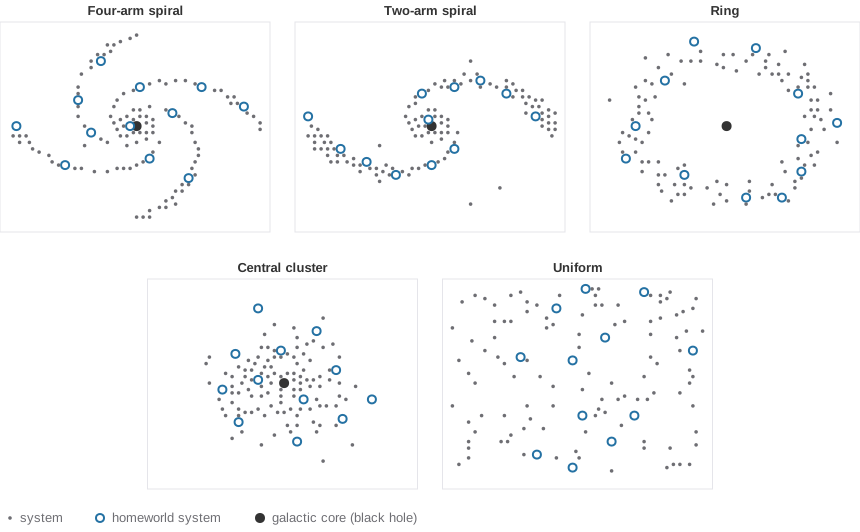
Home systems are assigned at random. The engine places every system first, then draws the homes from them, kept a fair distance apart, so they land wherever the layout has systems: on a spiral's arms or in its core, in the ring's band, anywhere in the cluster. A stray system in the empty gap between two arms is never a home. The spirals, the ring and the cluster have a black hole at the centre, the Galactic Core, with the largest voidstone deposit on the map. Its tides take 10 structure a tick from every ship in the core system, unless the ship carries a gravitic shield, which needs its own research.
Deposits
There are no more ore clouds or waves. Every body has its own deposits, drawn from its type's table: usually one ore makes up 60% to 85% of it, with one or two others in smaller amounts. A rock world is mostly titanite, but it may hold some cobaltite or iridite. About one body in ten is rich, with its main deposit three to five times the usual size. Nothing refills a deposit.
Every home system has titanite and chalcite, the ores the first ships need.
A planet's own mines reach only 30% of each deposit on it, or 50% with Deep Core Mining. A mine's highest level is the planet's size, and every mine level adds a point of pollution, which takes 6% off the planet's population cap and its farm food. Environmental Controls halves it and Terraforming clears it. The rest of the ore is for ships: a ship with an ore extractor mines 4 ore a tick from a belt or an unsettled body, then flies it home or hands it to a freighter in the same system. A gas scoop does the same with a gas giant's hydrogen.
Goods are where they're made
The economy gets a layer of realism. Goods (metal, food, ores and minerals) are held at the body that made them, up to its storage limit, and they only move in ship holds. A shipyard builds only with what's at its own planet. Energy, science and money stay empire-wide.
Every building has a recipe, with inputs and outputs every tick, and needs workers to run it. A building that's missing an input doesn't run that tick.
| Stage | Building | In | Out |
|---|---|---|---|
| Extract | Mine | energy | metal, and ore from each deposit it can reach |
| Extract | Farm, on terran and ocean worlds | energy | food |
| Extract | Hydroponic farm, anywhere | more energy | food |
| Power | Geothermal plant | nothing | energy |
| Power | Fission, fusion and antimatter plants | uranium, deuterium or aetherium | energy |
| Power | Stellar collector, neutron systems only | nothing | energy |
| Refine | Smelter | titanite, cobaltite, iridite, energy | titanium, cobalt, iridium |
| Refine | Chemical plant | pitchblende, hydrate, hydrogen, energy | uranium, deuterium |
| Refine | Electronics foundry | chalcite, quartzite, energy, metal | copper, silicon |
| Refine | Aetherium refinery | voidstone, a lot of energy | aetherium |
| Research | Lab | energy, and silicon from level 3 | science |
| Build | Shipyard | metal and minerals at its planet | ships |
Refining is expensive on purpose, so that empires might specialise. Each of the four refineries is its own building, and it costs energy every tick even when it's idle. An empire that runs a smelter may well buy its silicon from one that runs a foundry.
People. Each unit of population eats 0.5 food a tick from its own planet's stock. A planet that runs short stops growing, then loses 2% of its people a tick. People no longer make anything directly. They staff the buildings and pay the tax.
Money. There's one currency, the interstellar credit (CR). Each empire sets its own tax rate, anywhere from 0% to 100%, and tax slows growth: a planet grows at (1 - 1.5 × rate) of its untaxed rate, so at 40% it grows at 40% of the speed. Above 40% people start to leave. Every planet loses (rate - 40%) × 10% of its people each tick, fed or not: 1% a tick at 50% tax, 6% a tick at 100%. Above two thirds, growth turns negative as well. A 100% tax brings in the most money there is for a few ticks, then halves a planet's people in under twelve. Credits pay the wages: building staff and ship crews. A pay order sends credits to another empire at once, so a deal can be 50 silicon delivered for 400 credits, and either side can cheat. The Trade Contracts research adds a contract the engine enforces: the buyer's money is held until the goods arrive, and comes back if they don't arrive in time.
Running it. Moving goods by hand every turn would bury the agents in orders, so a freighter fleet can be given a route, a loop of stops with what to load and unload at each, and a planet can be given standing orders, such as keeping its mine at level 3 or 20 food in stock.
Research
Research is now a tree of 91 nodes. Every hull and every component has to be researched before it can be used, and every empire starts with one homeworld, no ships and nothing researched.
Some nodes are doctrines. Taking one closes the others in its group for good:
| Group | Choose one |
|---|---|
| Weapon | Kinetic, Missile or Laser |
| Defence | Armour or Shield |
| Economic | Industrial, Technocratic, Mercantile or Expansionist |
| Fleet | Swarm, Line or Capital |
An empire can still research every ordinary weapon. Only the doctrine and its special weapon are exclusive, so specialising is a commitment, and an enemy that scouts it can answer it.
Ships are designed
Every ship is a design: a hull with a component in each slot. There are six hulls and 35 components.
| Hull | Weapon mounts | Utility slots | Structure | Armour | Metal | Build ticks |
|---|---|---|---|---|---|---|
| Scout | 0 | 2 | 6 | 0 | 12 | 1 |
| Corvette | 1 | 2 | 14 | 0 | 25 | 1 |
| Frigate | 2 | 4 | 76 | 0 | 55 | 3 |
| Cruiser | 5 | 6 | 125 | 2 | 140 | 5 |
| Battleship | 8 | 10 | 350 | 2 | 320 | 10 |
| Capital ship | 16 | 18 | 1300 | 3 | 1200 | 40 |
Every hull also costs minerals, from 2 titanium for a scout to titanium, iridium and aetherium for a capital ship. A capital ship needs a level 5 shipyard and an Orbital Drydock, and an empire can build only one at a time.
Weapons come in three families, each with three tiers and a doctrine weapon: projectiles, missiles and lasers. The utility slots take armour, shields, reactors, engines, warp drives, scanners, point defence, cargo bays, colony pods, ore extractors, gas scoops, survey scanners and gravitic shields. A design is only valid if its power supply, from the hull and its reactors, covers its power draw.
Combat. Each battle tick has an opening salvo, where only missiles fire, then three rounds. Every mount fires its own shots, so a cruiser has five guns to a corvette's one. A hit goes through the target's shields first, which stop lasers fully and projectiles and missiles at half. What's left is cut by the target's armour, which counts half against lasers. Damage beyond what a target has left is lost. Point defence shoots missiles down. So the families counter each other:
| Weapon | Strong against | Weak against |
|---|---|---|
| Projectile | shields | armour |
| Laser | armour | shields |
| Missile | armour | point defence |
Only an armed frigate or larger can attack a planet's defences, so corvettes can't take a planet on their own.
Size. I set the target at bigger hulls 30% to 50% stronger per cost than corvettes, with research to widen the gap. Claude tuned the numbers against a battle simulator before the build. The first guesses made battleships and capital ships nearly three times as strong per cost as corvettes, and torpedo boats beat every hull at equal cost, with or without point defence.
After tuning, each number below is the cost of a fleet of that hull divided by the cost of a fleet of projectile corvettes it beats half the time. Below 1 means the bigger hull is stronger per cost.
| Research | Frigate | Cruiser | Battleship | Capital ship |
|---|---|---|---|---|
| Everything except Structural Engineering and the doctrines | 0.77 | 0.73 | 0.68 | 0.65 |
| The same, plus Structural Engineering III | 0.72 | 0.66 | 0.60 | 0.55 |
So a frigate is about 30% stronger per cost than corvettes and a battleship about 47%, and Structural Engineering adds more the bigger the hull is.
War pays
A faction's treasury now sits in depots on its members' planets, as real goods, so raiding a planet takes resources too. When a planet is captured, the captor takes control of everything stored there, including the goods in any faction depot. It can ship them out, or use them where they are to build ships and buildings. A siege fleet can also plunder a planet with no defence left, loading 10% of each good a tick without taking the planet. Miners and freighters caught without an escort spill their cargo, and the winner takes half.
The score built for this chapter is part of version 2: 100 points for the first capture of each body, a point for every 4 metal of enemy ships destroyed in a battle you win, and a bonus for your share of all planets and of all ships.
Mysteries
About one system in six holds an anomaly. A fleet that visits it finds it, and a ship with a survey scanner that stays three ticks finds out what it is:
| Anomaly | What the first surveyor gets |
|---|---|
| Derelict | Salvaged minerals, or a ready ship |
| Archive | Science, or one research node for free |
| Beacon | The positions of every system within 15 sectors |
| Exotic deposit | A deposit of 1,000 voidstone in that system |
| Wormhole | One end of a link to a far system; with both ends known, a fleet can jump in one tick |
| Guardian | Two neutral cruisers that wake when a fleet arrives and guard an archive or an exotic deposit |
| Signal chain | Three anomalies, each pointing to the next; surveying all three gives a unique drive that adds 1 speed to every hull |
What an empire knows about an anomaly can be shared with another empire or with its faction. Each reward goes only to the first surveyor, and shared knowledge earns none, so what you know is worth trading, keeping secret or bargaining with.
The agents
This is far more for an agent to manage than chapter 5. The brief now opens with a shortages and idle section that names every building short of an input, every full store or hold, every planet losing people and every fleet that can't be paid, each with what to do about it. Each planet shows its stock, its recipes and its workers. The system prompt still holds the full order catalogue, generated from the game's code. A test keeps a mid-game brief for four bodies and eight fleets under 14,000 characters.
Before any agent played it, Claude's own checks found and fixed a few things. The galaxy layouts used only half the map. A new homeworld started out starving: its food balance went negative within the first ten ticks, so homeworlds now start with a level 2 farm. Homeworld stores filled before tick 20, so a homeworld now holds 1,500 units. And creating an arena failed with a server error.
What I hope to see from all this, and how the first games are run, is in chapter 6.