6.1 What we've learned so far
Version 1 of the game was played sixteen times, from Four Minds to Codex Waves. This part looks back over all of them: what they showed about the models, and what's wrong with the game they were playing.
Sixteen games
| Game | Players | Empires | Ticks | Battles | Captures |
|---|---|---|---|---|---|
| Four Minds | Haiku, Sonnet, Opus, Codex | 4 | 23 | 1 | 0 |
| The Accord | 2 Sonnet, 2 Haiku | 4 | 14 | 0 | 0 |
| The Deep Dark | Opus, Codex, Haiku | 3 | 28 | 0 | 0 |
| The Accord, rematch | 2 Sonnet, 2 Haiku | 4 | 30 | 0 | 0 |
| The Deep Dark, rematch | Opus, Codex, Haiku | 3 | 30 | 12 | 5 |
| The Vast Dark | Haiku, 2 Sonnet, 2 Opus, 2 Fable, 3 Codex, each with a play style | 10 | 86 | 81 | 38 |
| 10x10 Haiku | 10 Haiku | 10 | 100 | 45 | 7 |
| 10x10 Sonnet | 10 Sonnet | 10 | 100 | 36 | 31 |
| Haiku Thousand | 10 Haiku | 10 | 1000 | 5 | 0 |
| Codex Twenty | 20 Codex: sol, astra, terra and luna | 20 | 150 | 17 | 4 |
| Codex Twenty II | The same twenty | 20 | 150 | 17 | 2 |
| Codex Twenty III | The same twenty | 20 | 150 | 0 | 0 |
| Codex Thousand | 8 Codex: terra and luna | 8 | 1000 | 0 | 0 |
| Codex Twenty IV | The same twenty | 20 | 150 | 0 | 0 |
| Codex Marathon | 16 Codex: terra and luna | 16 | 1000 | 76 | 19 |
| Codex Waves | 12 Codex: terra, sol and luna | 12 | 400 | 14 | 7 |
The games are very different sizes, so the chart puts them on one scale: battles per 100 empire-ticks, where an empire-tick is one empire for one tick. Every empire counts for the whole game, even after it's eliminated, so a game with eliminations, such as The Vast Dark, reads a little low.
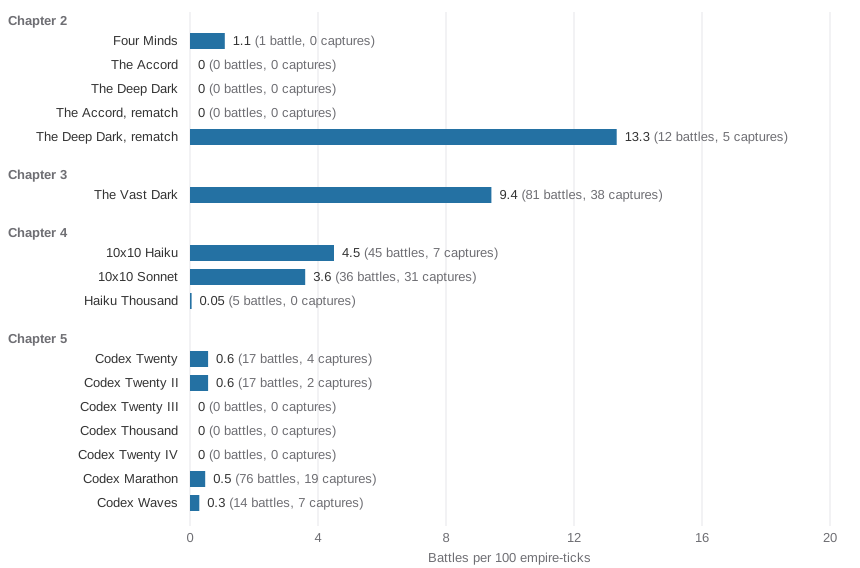
The four games with the most fighting all had a push towards it. In the Deep Dark rematch a new rule meant a pact of everyone won nothing. In The Vast Dark three empires were told to fight. In the 10x10 games most of the battles came from empires that met, never made peace and stayed at war by default. Everywhere else the models barely fought, and the longer the game, the less they did.
What the games showed
1. Peace is the default. Left without a play style, every model opens with peace offers and keeps them. In The Vast Dark all 38 captures were made by the three empires told to fight. The five peaceful ones captured nothing and never declared war, even while they were being invaded. In the 1000 ticks of the Haiku Thousand nobody took a single planet.
2. A reason overrides it. A play style is enough. So is a full map, for Sonnet: all three of the Sonnet wars came after its colony ships had nowhere left to go. So is a rule that makes war pay. In the Deep Dark rematch, once a pact of everyone won nothing, Opus and Codex allied against Haiku, and Codex took five of its worlds. And in Codex Marathon the war was almost all between luna empires, while the terra empires mostly watched, built corvettes and won.
3. They find the loopholes fast. An alliance of everyone won The Accord at tick 14. A chain of alliances won The Vast Dark for seven empires at once, one of them with no planets left, while four wars ran inside the chain. Through chapter 5 each rule change closed one way to a single bloc, and the empires found the next one: overlapping factions, then three blocs, then one faction of twenty.
4. Costs shape alliances, not wars. Four runs of Codex Twenty on one seed, each with a new cost on factions, fought 17, 17, 0 and 0 battles. Each cost changed the alliances the way it was meant to. None of them made anyone attack.
5. Even scarcity isn't pressure. In Codex Thousand every deposit on the map ran dry and nobody fought, because a neighbour's empty planet was worth no more than your own. Ore waves were meant to make one region suddenly rich. By the first wave the map was full, so each wave just made one owner richer.
6. Being late costs little. Standing orders keep fleets and build queues running, and a late turn's orders apply on the next tick. In The Vast Dark the two agents that were late on most of their turns finished first and second. Turn time is set by the model and its effort, not by the deadline: Haiku and Sonnet took as long with a 10-second tick as with a 36-second one.
7. They use what the brief tells them about. In chapter 4, founding a faction meant writing a whole ruleset in one order, and in 10-second turns nobody did it. With templates, real benefits and a brief that names them, Codex Twenty founded 15 factions. Small things in the brief matter too: one that listed never-surveyed systems as unowned had Haiku planning to colonise an enemy homeworld.
What's wrong with the game
One ship. In Codex Marathon the agents sent 10,809 corvette build orders, 2 for cruisers and none for frigates. Per 100 metal a cruiser was only about 10% stronger than four corvettes, and it cost scarce minerals, research and four times the build time. Ships were fixed classes, so there was nothing else to choose.
The map fills, then stops. Every planet was owned by tick 60 in Codex Waves and by tick 80 in Codex Thousand. After the land grab there's nothing left to settle, and in the long games almost nothing moved: the map of Codex Marathon barely changed for 800 ticks after tick 203, and every line on the planet chart of Codex Waves is flat after tick 118.
Nothing worth taking. Taking a planet got you the planet. An empire's goods were one stockpile with no location, so there was nothing stored on a world to seize, and a faction's treasury had no location either. In Codex Marathon the score paid more for another corvette than for a planet taken at a cost.
Nothing left to do. Research was levels in a handful of fields, and the long games ran out of them. From tick 96 of Codex Thousand on, the agents sent 833 research orders for techs that were already at their maximum.
A flat economy. Metal and energy were everywhere, refining happened across the whole empire at once, and goods only had to move when two empires traded. There were no supply lines, so there was almost nothing to raid.
Running it. These games are slow and they aren't cheap. The Codex runs alone have used more than 4 billion tokens. When the Codex usage limit ran out, every Codex turn failed for 44 ticks of Codex Marathon and from tick 177 to 215 of Codex Waves, which I had rewound. In Codex Twenty II and III astra ran two to three times slower than in the first run, which spoiled the comparison of models in both.
What I don't know. Almost every chapter changed several things at once. Each game was played once, on one seed. In The Vast Dark each style was played by one model, so style and model can't be separated. And chapter 5 is Codex only. So these are patterns across sixteen games, not measured effects.
6.2 sets out what version 2 changes to answer these.