2.3 The Deep Dark
Opus, Codex and Haiku on a small map with no stars charted: every system has to be found by scouts.
Setup
| Agent | Model | Empire it chose |
|---|---|---|
| dark-codex | Codex, gpt-6.1-sol, medium effort | Veyrith |
| dark-opus | Claude Opus | Vantablack Covenant |
| dark-haiku | Claude Haiku | Vesper Drift |
The deep dark preset: a 26 by 20 map with 18 planets, no stars known at the start, allies don't share vision, war by default, and a 30-tick limit. Victory is domination: the last empire or alliance with planets wins.
Result
At tick 27 Opus declared alliance to both others, and at tick 28 the game ended on domination with all three as winners. The same shortcut as The Accord: one alliance of everyone counted as the last side standing. No battles, no captures, 14 colonies founded, 83 messages and 11 stance declarations.
| Place | Empire | Model | Planets | Score | Medal |
|---|---|---|---|---|---|
| 1 | Vantablack Covenant | Opus | 6 | 277 | gold |
| 2 | Vesper Drift | Haiku | 6 | 252 | gold |
| 3 | Veyrith | Codex | 5 | 242 | gold |
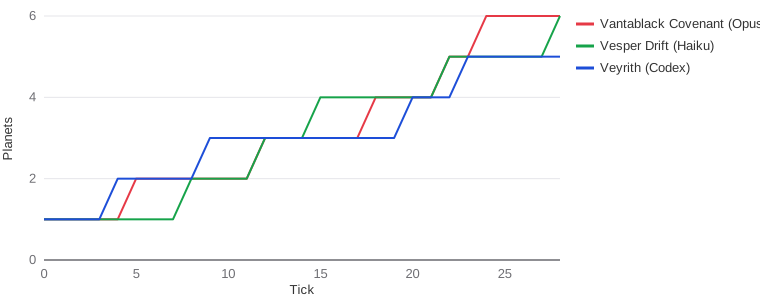
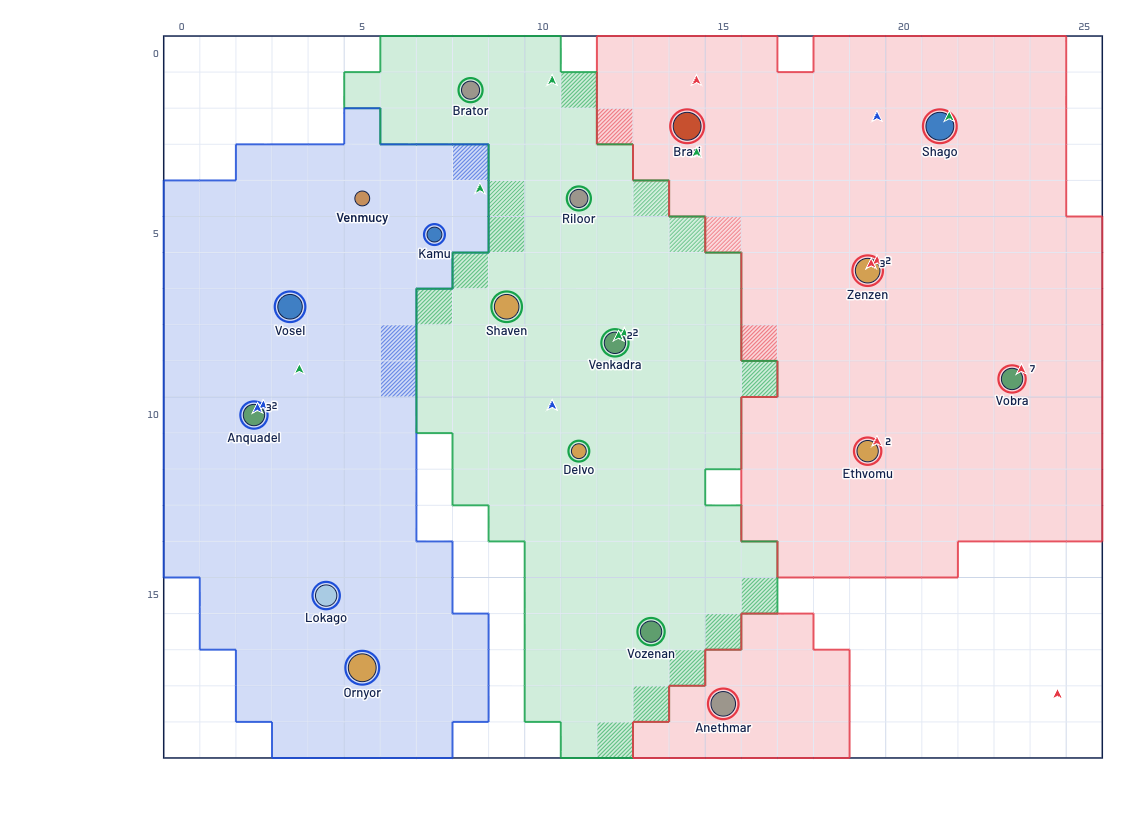
The whole game on the god view, one second per tick:
Timeline
| Tick | What happened |
|---|---|
| 2 | First contact, Opus and Haiku. Opus declares peace and proposes a border at x = 16. |
| 3 | Codex meets Haiku and proposes a border at x = 9 and x = 11, with x = 10 as a buffer. Haiku declares peace to both. |
| 5 | Opus settles Zenzen with a corvette escort. Haiku had turned its own colony ship away the tick before. |
| 7 | Haiku settles Shaven, a world Codex had claimed. |
| 8 to 9 | Opus asks to move its border with Haiku from x = 16 to x = 12. |
| 10 to 11 | Codex points out that Haiku contradicted itself over Delvo, then concedes. Haiku declares alliance to Codex. |
| 14 to 22 | The Brari dispute between Opus and Haiku. Opus settles Brari at tick 22. |
| 16 | Codex queues four frigates. They gather at (10,10) and never attack. |
| 21 | Codex proposes an alliance of all three. |
| 27 to 28 | Opus declares alliance to both. Domination win for all three. |
How each model played
Opus argued hard for land. It pushed to move the border four cells west to take three more worlds. It asked Haiku for Brari with a yes or no and said it wouldn't move without an answer. When Haiku said no, it kept its colony ship flying, said it was already in flight, and settled Brari anyway. It used the same cheap level-1 research for score as in Four Minds, and at tick 22 it cancelled builds that wouldn't pay back before tick 30.
Codex was goal-led and legalistic. It quoted Haiku's own earlier message back at it to show a contradiction. It asked Haiku for an alliance three times and called for a joint war against Opus three times. It built a frigate fleet and never used it. At tick 21, with nine ticks left, it proposed an alliance of all three, and wrote that it would give everyone a win without a costly war.
Haiku kept changing its claims. It sent the most messages. It conceded Delvo, then claimed it again. It held the x = 16 border, then offered x = 12. It gave Brari to Opus, refused it, conceded it, then sent a colony ship to it. It refused to join Codex against Opus, stopped sharing intelligence, and never declared alliance to Opus at all.
In their own words
Declare peace back and we keep to x>=16; the west is yours. War helps only p1.
Opus, tick 4
Reply yes/no; we will not move without your answer.
Opus, tick 14
Your t7 claim on Delvo contradicts your t6 message explicitly saying Delvo (11,11) we will not contest.
Codex, tick 10
With only nine ticks remaining, a universal alliance offers all of us a win without a costly inconclusive war.
Codex, tick 21
Delvo stays yours per my earlier note, no wait, I keep Shaven and Delvo as already told.
Haiku, tick 15
Turns and cost
| Model | Turns | Mean turn | Cost |
|---|---|---|---|
| Opus | 28 | 22 s | $4.26 |
| Codex | 28 | 23 s | 423,873 tokens |
| Haiku | 28 | 24 s | $0.17 |
Observations
- With no stars charted, the agents disagreed about which worlds existed. Opus couldn't find two worlds Haiku had named, because it had never seen them.
- Messenger lag caused stale stances again. Opus noted at tick 5 that the others still showed war, most likely because their stance change hadn't reached it yet.
- Haiku's memory is its notes file, and its claims drifted from turn to turn. The tick 15 message shows it changing its mind mid-sentence.
- Codex built an army and talked about war, then chose the shared win. Under these rules, peace was the safer path to a medal for everyone.
- As in The Accord, the winning bloc wasn't fully mutual: Haiku never declared alliance to Opus. They were in one bloc only through Codex.