3.1 A, Sled Tower
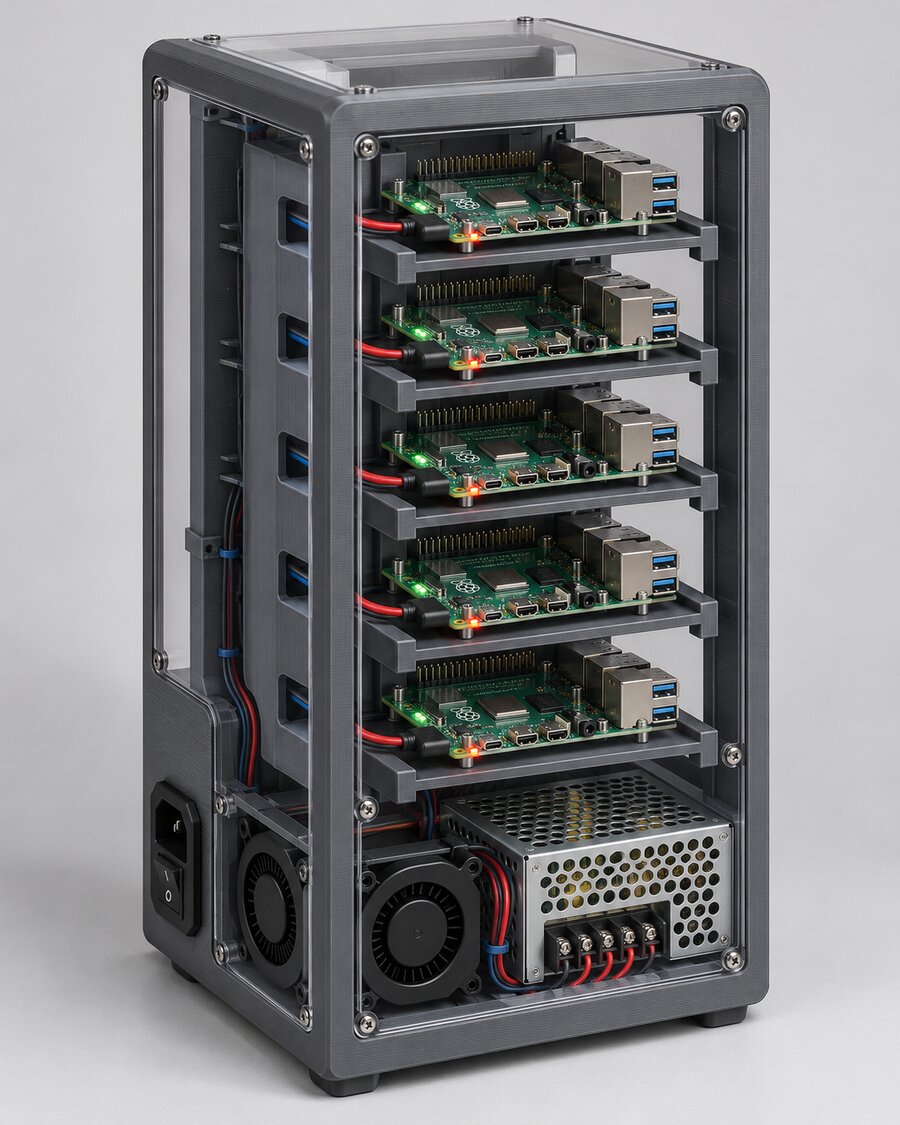
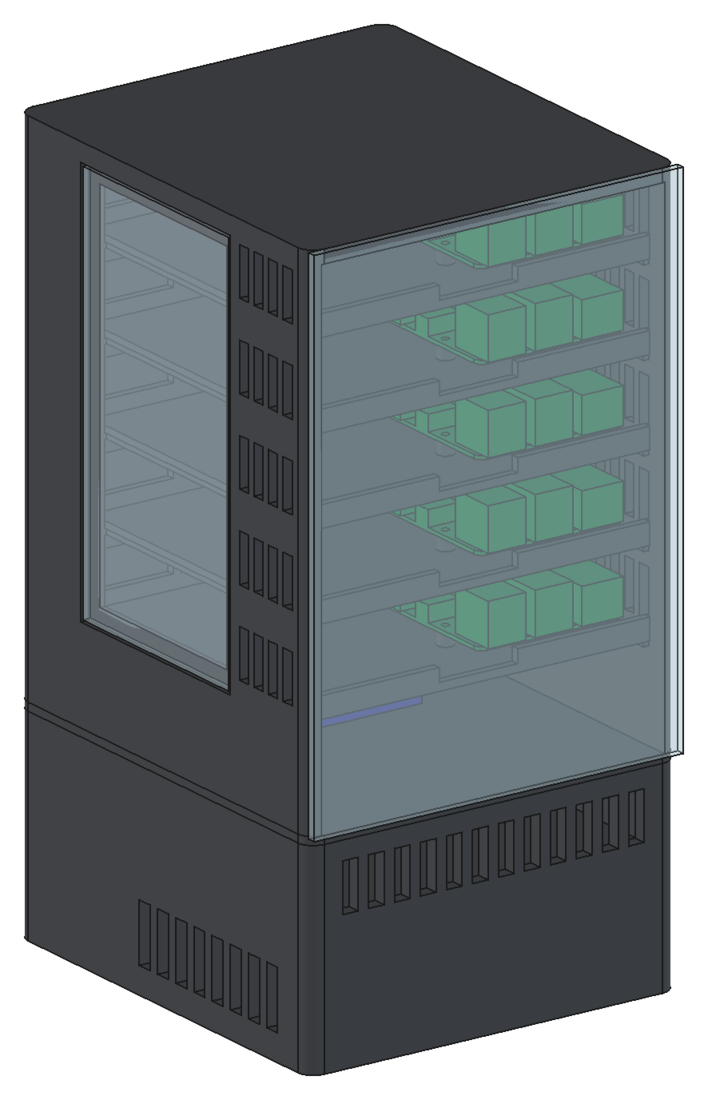
Five boards lie flat on trays that slide in from the front, like a tiny server rack. It's 142 × 163 × 277 mm, the second tallest of the four, and the only one where a board comes out without touching the others.
The plinth
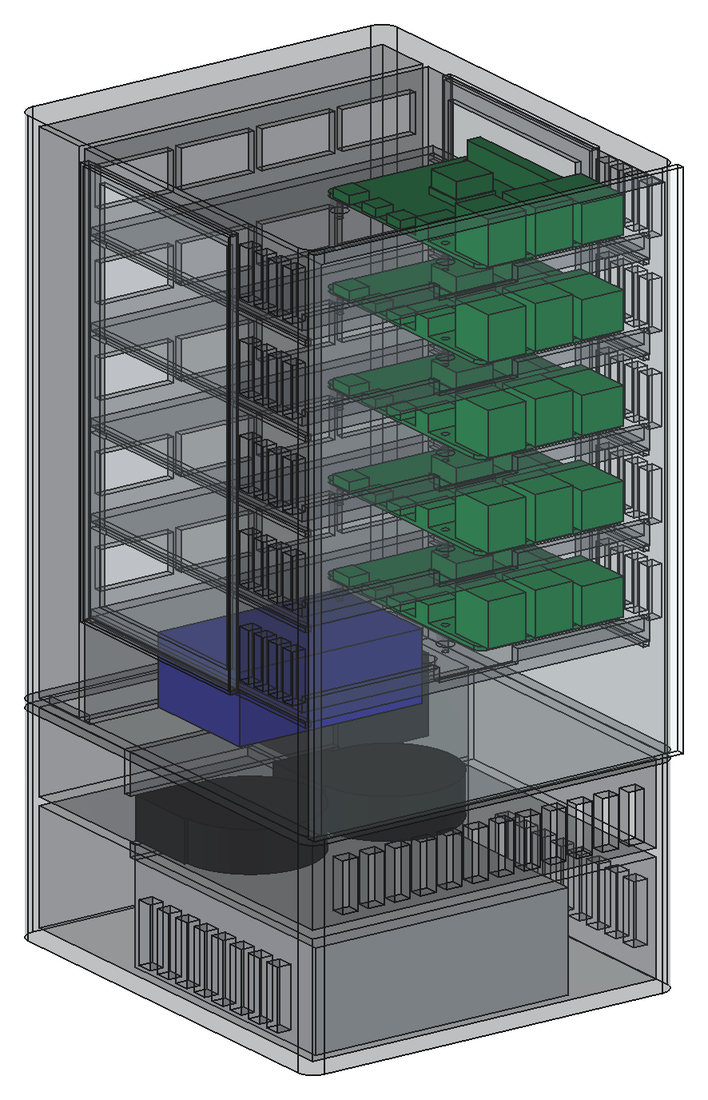
The plinth is 77 mm tall and has two levels. Inside it measures 132 × 150 mm, with 5 mm walls.
- Lower level. The power supply lies flat on the floor with its terminals facing back. It sits 4 mm in from the front and left walls, so its terminal end is at 103 mm from the front. Behind it, a closed mains compartment runs to the back wall, 47 mm deep. The supply has its own vents: slots in the floor under it and in both side walls, low down. Its 7 W never meets the boards' air.
- Upper level. A 3 mm shelf at 44 mm closes the supply's level. The two blowers lie on it, side by side, outlets facing back. They draw air through a grille in the front of the plinth and blow it into a plenum at the back left, 80 mm wide.
- The inlet sits in the back wall at the upper level, 48 to 76 mm up, in the right-hand 50 mm that the plenum doesn't use. A wall closes that corner off, so the compartment is one pocket that runs from the terminals up to the inlet. Its body is over the terminal zone, not in it.
The tower
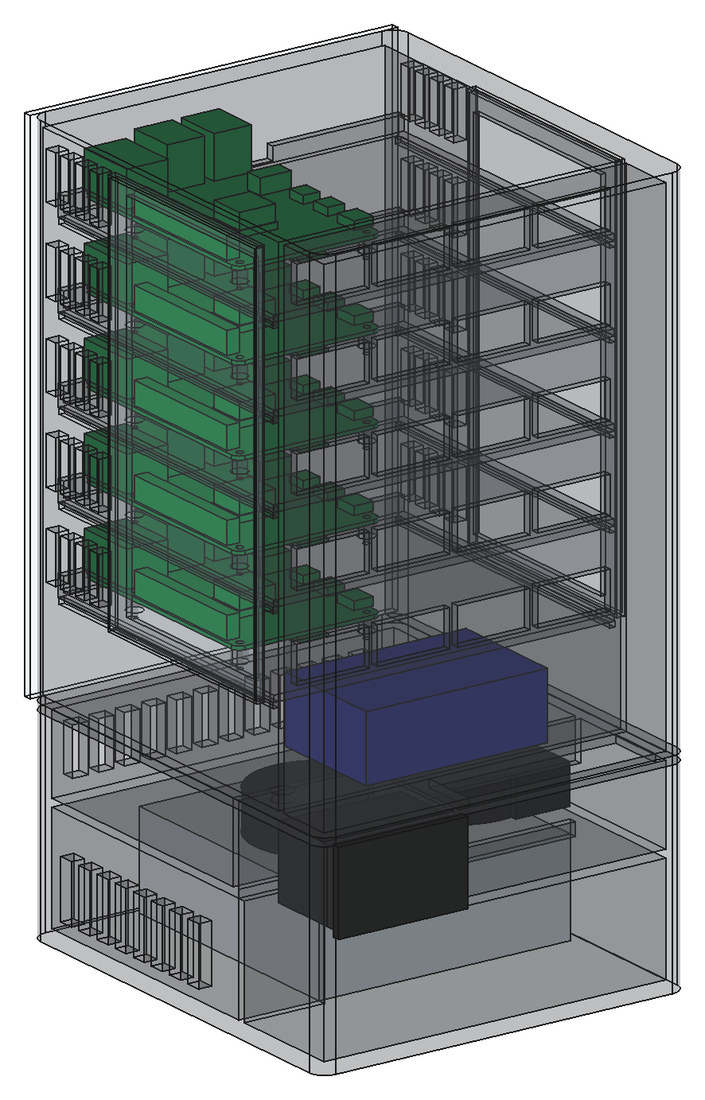
A 3 mm deck closes the plinth and is the tower's floor. A 72 × 22 mm opening at the back left lets the plenum's air up into the duct, and an 8 mm hole lets the 5 V leads up from the compartment.
- The fuse bay. The first 35 mm above the deck hold the power hub, lying flat, leads facing forward. It's behind the door, so a fuse is easy to reach.
- Five trays, 32 mm apart, the first at 115.5 mm. A tray is a 2.5 mm plate with a front lip and a finger notch, and four 5 mm standoffs tapped for M2.5. It rests on 2 × 2 mm ribs on the inside of each wall, with 0.3 mm of clearance a side.
- The board sits with its USB and Ethernet jacks facing the door, so they show, and its USB-C edge to the left. The board starts 70 mm from the left wall. That leaves a 56 mm channel down the left side for the right-angle plugs and the leads to the hub.
- The duct runs up the back, 22 mm deep and the full 132 mm wide, behind a 3 mm wall. At each tray the wall has four slots, 28 × 14 mm, starting 4 mm above the tray. Each board gets its own share of air, blowing from the back of the board to the front.
- The exhaust is four 5 × 18 mm slots in each side wall at each tray, near the front.
Each board sits in its own channel: the tray under it and the next tray over it, 29.5 mm apart. Take away the board and its parts and that's about 2,540 mm² of cross-section, the most of the four concepts. At 2 L/s shared five ways, the air moves at about 0.16 m/s. That's slow, which is the trade for the space.
Perspex
A front door, 197 × 142 mm, held on four 6 × 3 mm magnets. Each side has a 152 × 80 mm window in a 3 mm rebate on the outside of the wall, so the boards show from the side too.
Printing
| Part | Prints | Size (mm) | Orientation |
|---|---|---|---|
| Plinth | 1 | 142 × 160 × 77 | Upright, open top |
| Deck | 1 | 142 × 160 × 3 | Flat |
| Tower | 1 | 142 × 160 × 197 | Roof on the bed |
| Tray | 5 | 131 × 119 × 8 | Flat, standoffs up |
The tower is one print: two sides, the back, the duct wall and the roof. Upside down, the roof is on the bed and the open bottom is up, so it needs no support inside. The rails become 2 mm ledges, which print fine. The slots in the duct wall are the weak spot. Upside down, each slot's top edge is a bridge, and I've kept them to 28 mm so they'll bridge cleanly. That needs a test print before I trust it.
Balance
The estimated mass is 1.74 kg, with the centre of gravity 119 mm up. The nearest edge is 69.3 mm away in plan.
So it passes the tilt test easily, and doesn't tip until 30°. The push at the top of the roof (276.5 mm) that tips it is:
A light push with one finger is 5 to 10 N, so a deliberate shove would still have it over. It's heavy at the bottom, which helps: the power supply is a fifth of the total mass and sits 20 mm off the desk.
Good and bad
- Trays slide out with their boards, and the fuses are behind the door.
- The duct feeds all five boards in parallel, so the top one gets air as fresh as the bottom one.
- It's stable without any help.
- The tower is a 197 mm print. If it fails near the end, that's a lot of PETG gone. It could split into two sides, a back and a roof.
- From straight in front I see the boards edge on, through the door. Their faces only show from above or through the side windows.