6.4 Supercomputers
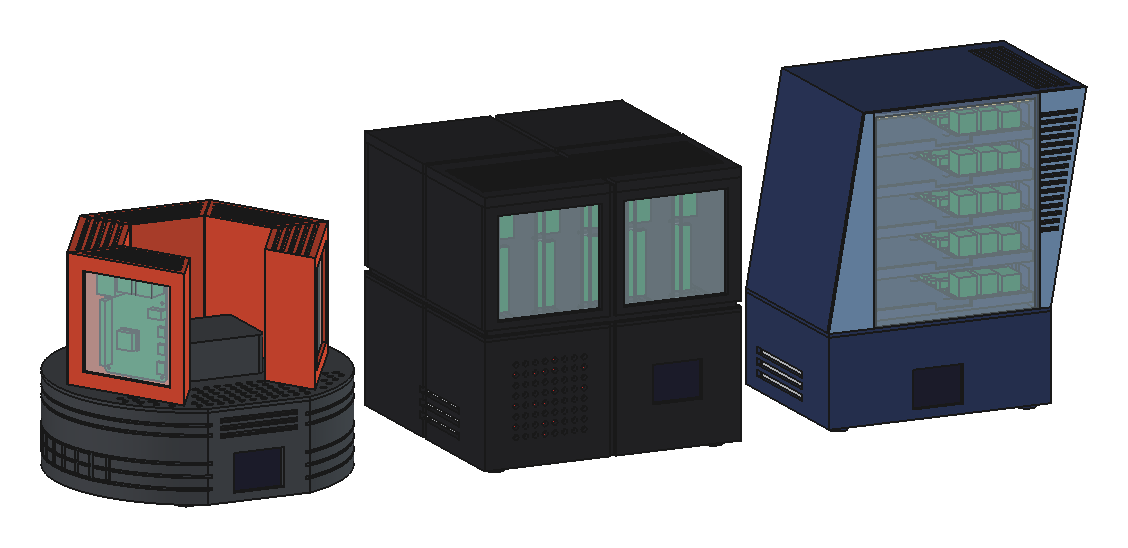
Seventeen designs in, I changed the brief. Instead of handing Claude a style, I asked for five more batches of three, and for each batch to start with research: go and find real design inspiration, then build from it.
Five Raspberry Pis in a box is a very small supercomputer, so batch one borrows from the real ones. The rule Claude set itself was a good one: take something from each machine that did a job in the original, not just its looks. Its notes and sources are in the repo, under concepts/inspiration/.
H1 Loveseat
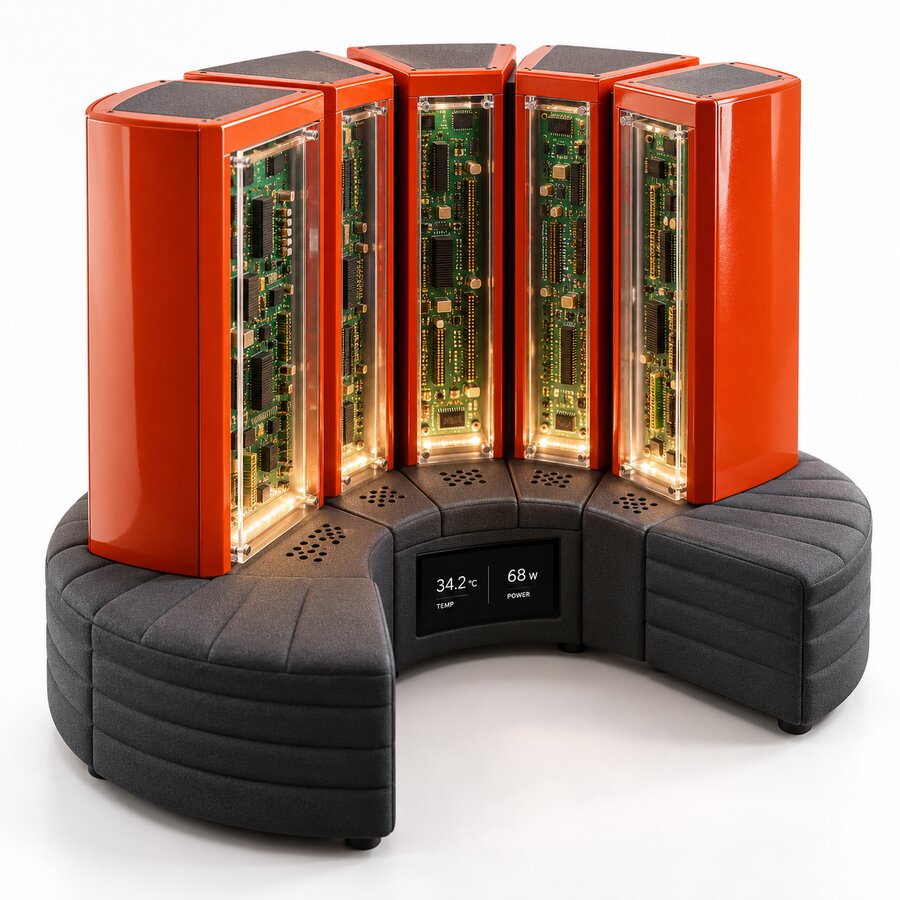
The Cray-1 from 1976 stands its twelve columns in a C, which kept the wires between them short at a 12.5 ns clock. The padded bench round the bottom wasn't just for sitting on: it hid the power supplies and the cooling. People called it the world's most expensive loveseat.
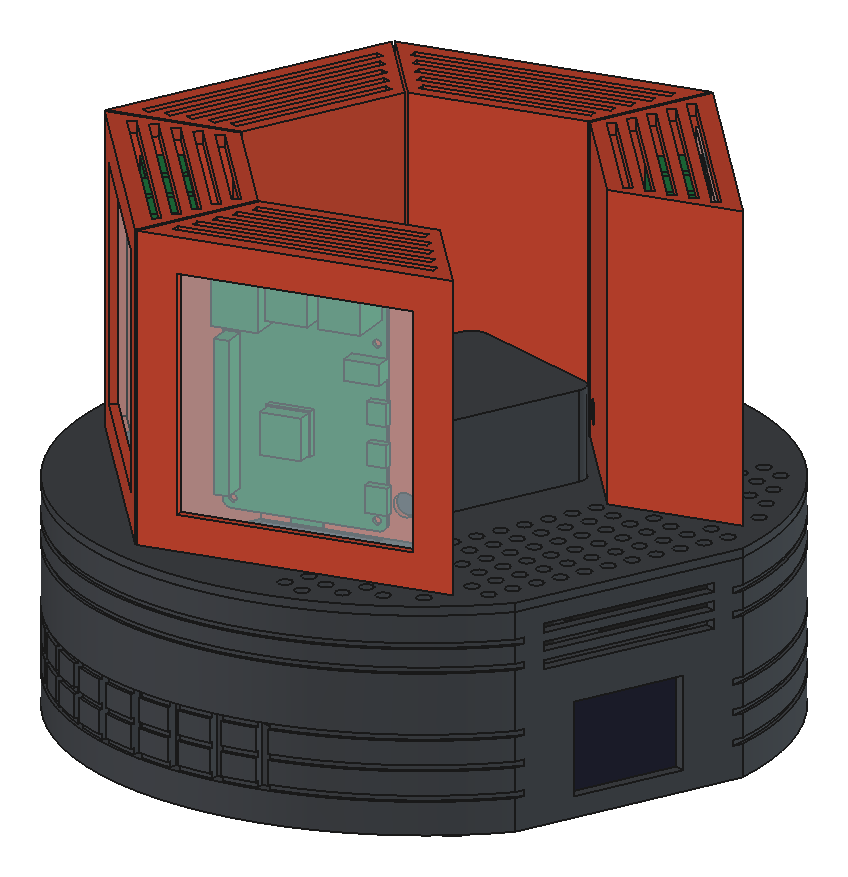
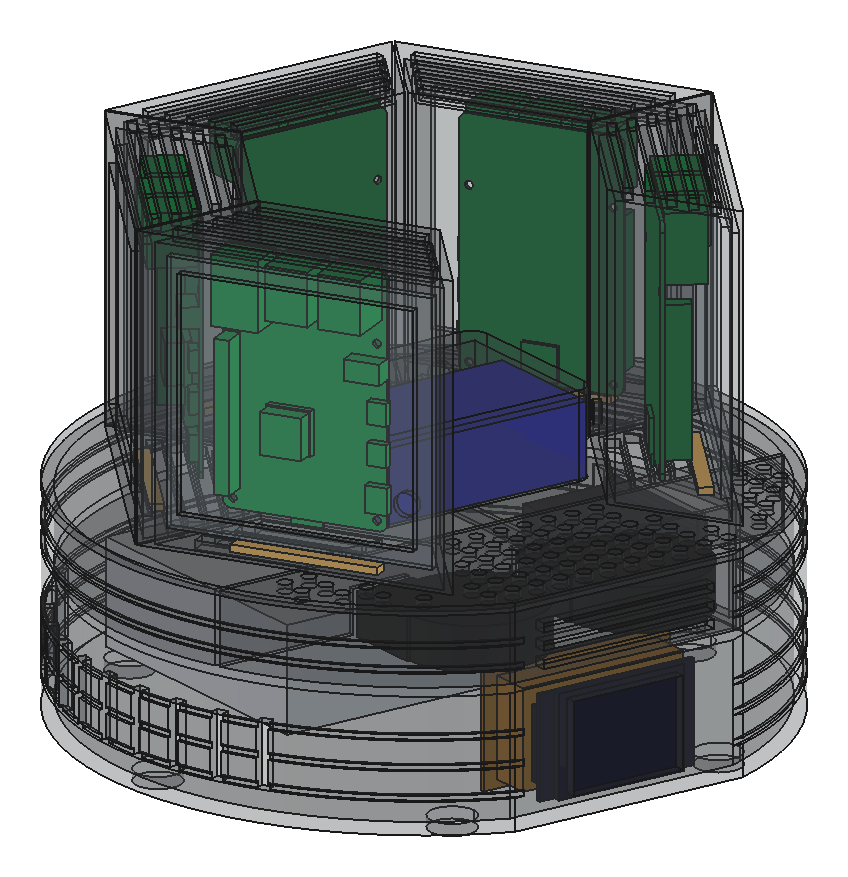
So H1 is five columns in a C, one board in each, standing upright and facing out through its own window. The bench does the Cray's job. Its lower level holds the power supply, the mains compartment and the screen, and its upper level holds the blowers and a plenum under all five columns. The air comes in through holes in the bench top inside the C, gets pushed up into each column, goes past the board and leaves through slots in the column's cap. The hub sits in the well inside the C, under a little black cover, so every USB-C lead is short. That's the Cray's reason for the C, too.
The C opens 60 degrees, not the Cray's 90, because a board and its right-angle plug need 70 mm across the column. The grooves round the bench are the upholstery.
H2 Hypercube
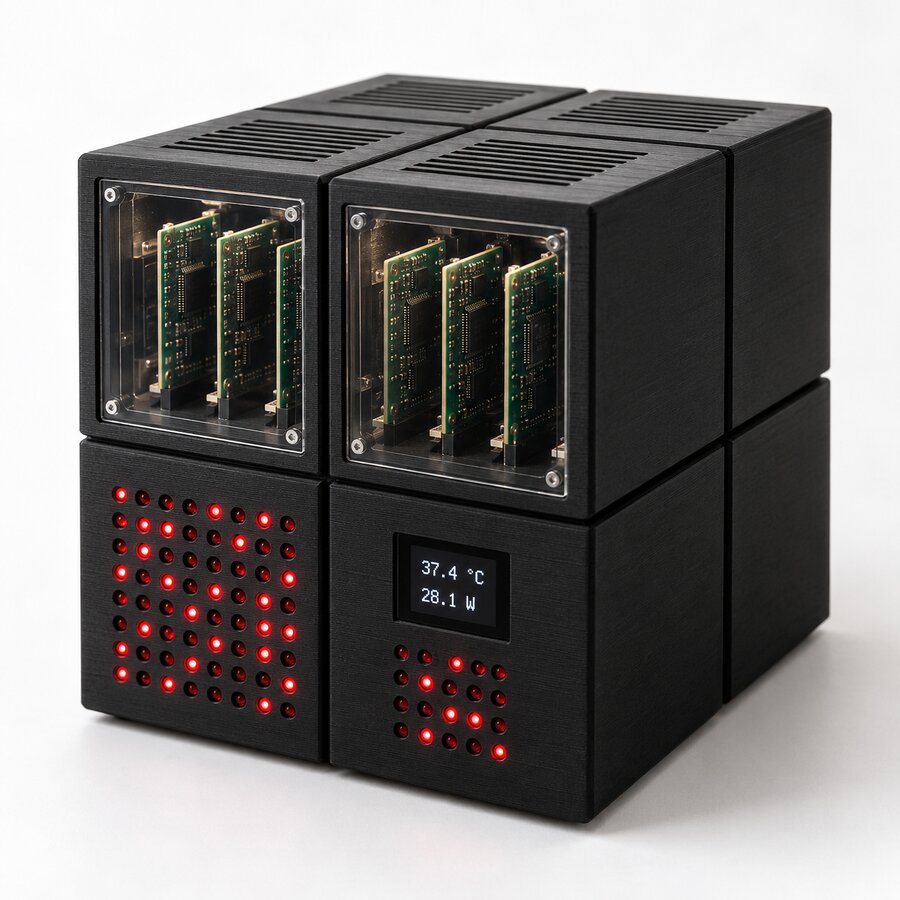
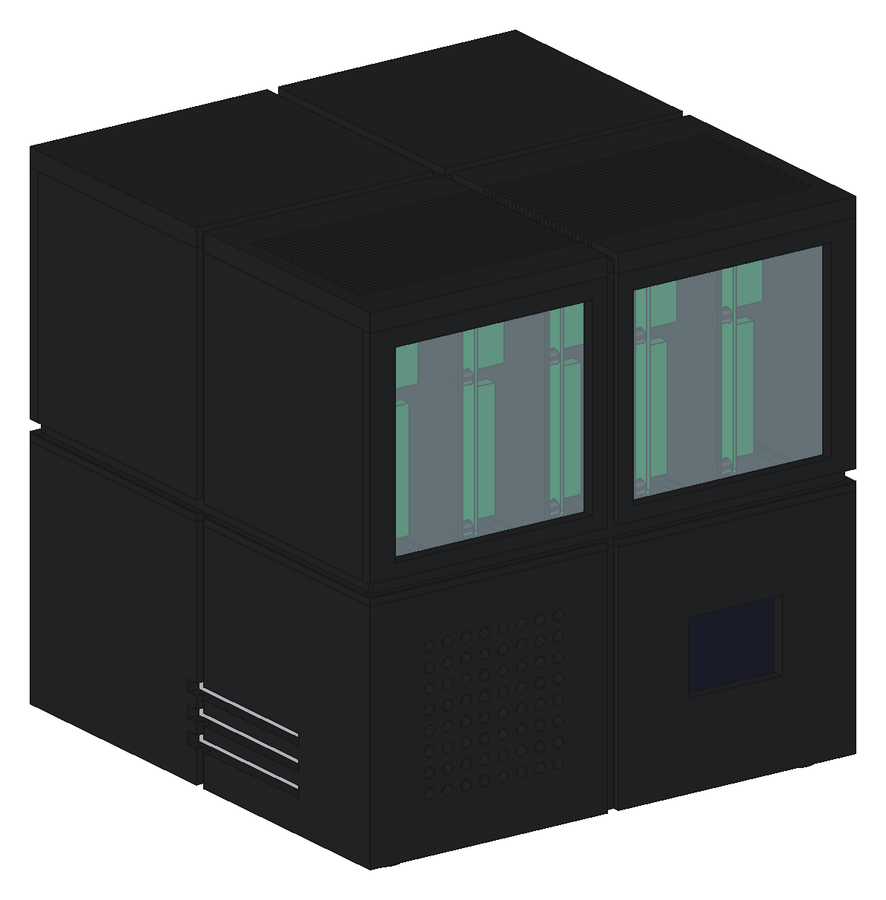
The Thinking Machines CM-1 from 1986, designed by Tamiko Thiel, is a 1.5 m black cube made of eight smaller cubes, a picture of the 12-dimensional hypercube network inside it. Behind its doors, red LEDs showed the processors working, and they became the machine's whole identity.
H2 is a 214 mm black cube with grooves across every face, B2's boards on edge behind two clear doors in the top half, and an 8 × 8 grid of holes over a red LED matrix in the bottom left, showing the five boards' load. The screen sits bottom right. The horizontal groove falls right at the joint between the base and the cage, so the cube-of-cubes line is also where it comes apart. A real cube is big, though: about 1 kg of filament.
H3 Lean Tower
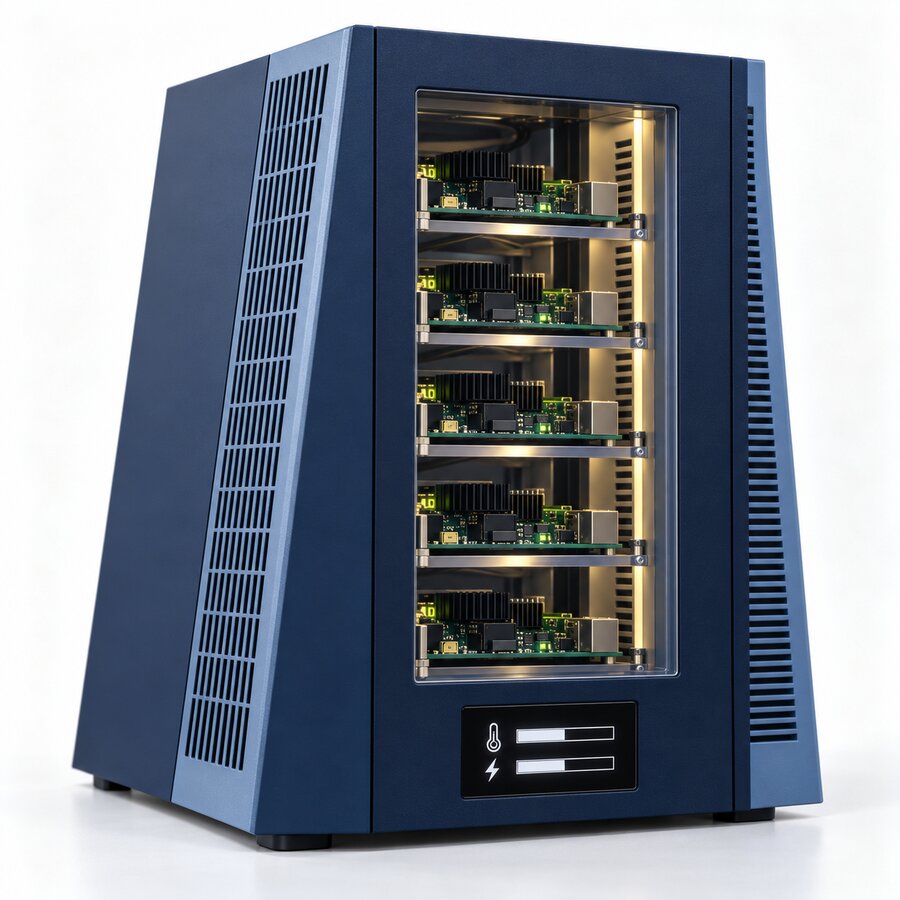
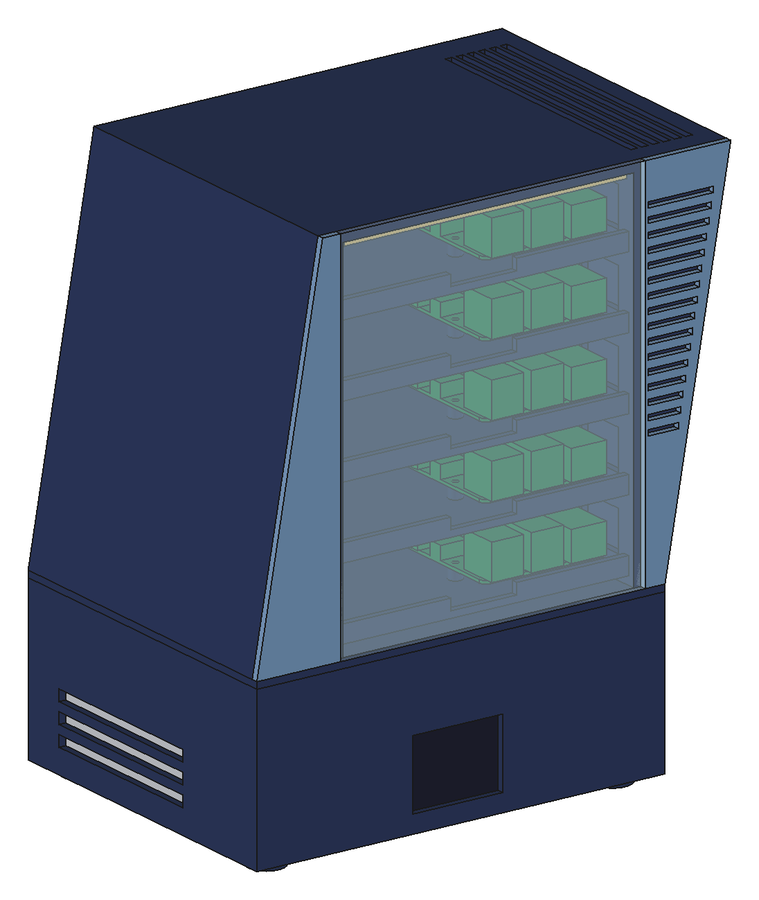
This one is pure engineering. Claude found an IBM patent, US7085133, for "complimentary tapered plenums" in supercomputer racks. A plenum feeding a stack of trays carries less air at each level, and one collecting from them carries more, so give each one a sloping wall: the intake narrows as it rises, the exhaust widens, and neither wastes space. The leaning cabinets of IBM's Blue Gene machines look just like it.
H3 puts A2's trays between two of them. The intake plenum on the left goes from 35 mm wide at the bottom to 6 mm at the top, the exhaust on the right does the opposite, and both outer walls lean 10 degrees the same way. So the front is a parallelogram, and that shape is the air path. ChatGPT drew it as a trapezoid, both sides leaning in, which misses the point; the model does it properly.
It's the cleverest of the three, and the least steady (3.9 N), because the top hangs 30 mm over the plinth.
The numbers
| H1 | H2 | H3 | |
|---|---|---|---|
| After | Cray-1 | Connection Machine CM-1 | IBM tapered plenums |
| Size, W × D × H (mm) | 236 × 228 × 182 | 214 × 214 × 218 | 215 × 148 × 248 |
| Boards seen | Face on, a window each | Edge on, through doors | On trays, through the door |
| Push at the top to tip it | 7.0 N | 6.9 N | 3.9 N |
| Mass, of which printed | 1.67, 0.60 kg | 2.04, 1.04 kg | 1.72, 0.73 kg |
All three pass every check with no ballast. Claude's pick is H1: boards face on through their own windows, short leads, and nearly the steadiest thing in the project. The catch is a 236 mm bench, the biggest print yet, which only just fits the A1.