6.5 Teenage Engineering
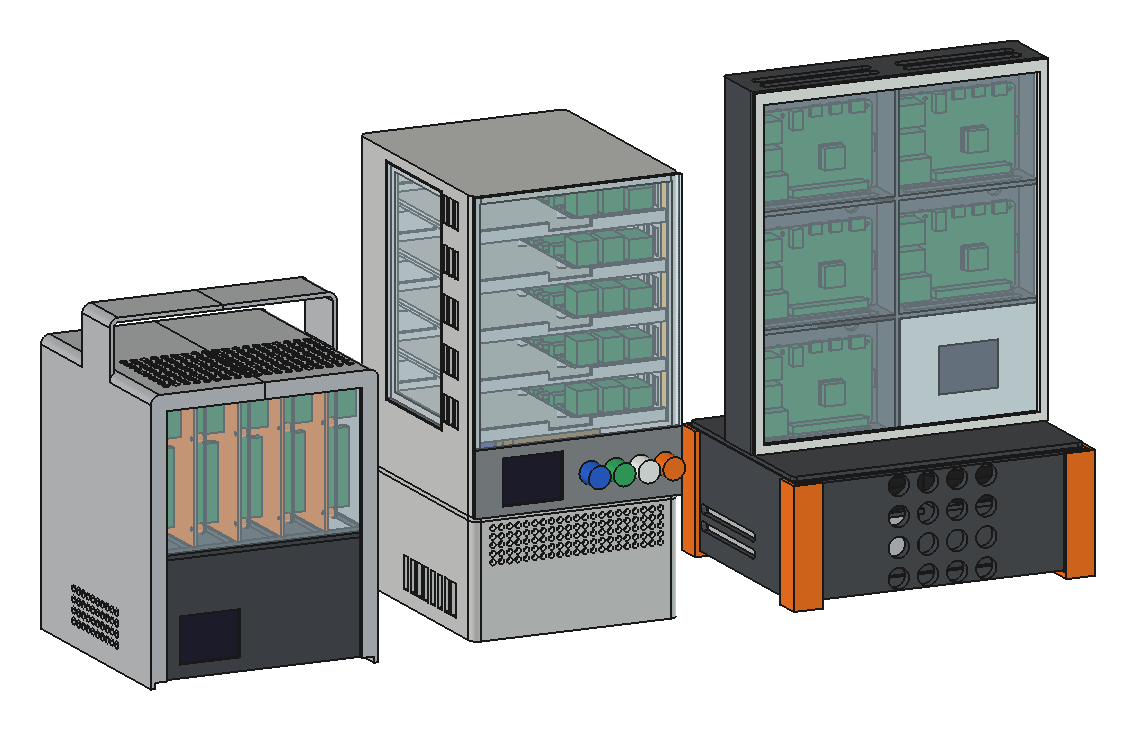
Batch two is Teenage Engineering, the Stockholm company behind the OP-1. Their stuff is playful but honest: you can see how it's made, and every colour or hole is there for a reason. Claude took one idea from each of three products.
T1 Fold
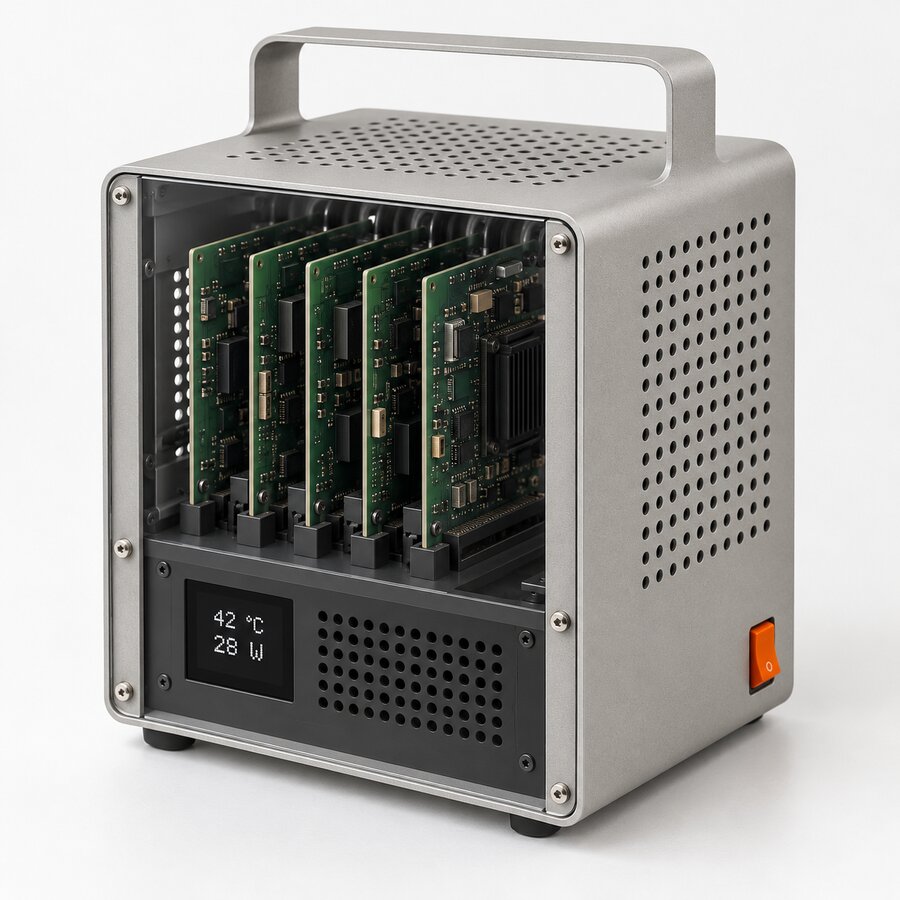
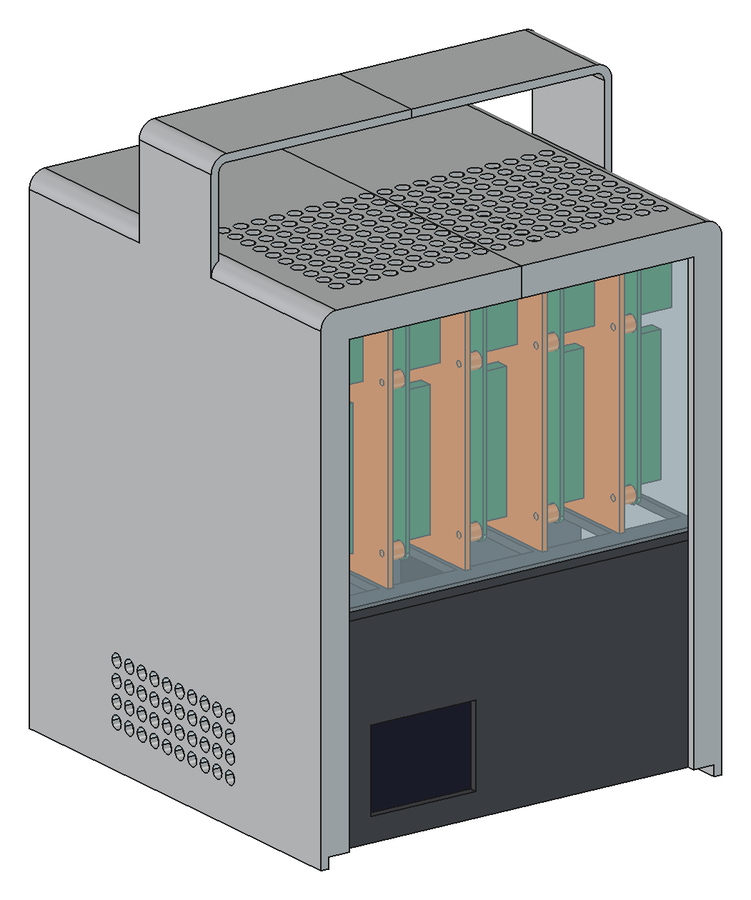
computer-1 is a PC case that comes flat: 1 mm aluminium you bend yourself along marked lines. Their first versions were board and Formica, and the handles broke under the weight; aluminium fixed it. The look is the process: bend radii, flanges, round punched holes, a handle folded from the same sheet.
T1 is one 3 mm band that is the left side, the top and the right side, with a sheet's bends drawn into it, and the sides carry on up and fold across into a handle. Flanges fold in at the front and back to hold the clear front. Every vent is a grid of round holes, and the blades holding the boards are orange, the one colour. Inside is B2 on a square plan. It's the lightest print of the batch at 0.46 kg, but the band has to print in two halves, and the handle needs testing before it carries 1.4 kg.
T2 Synth
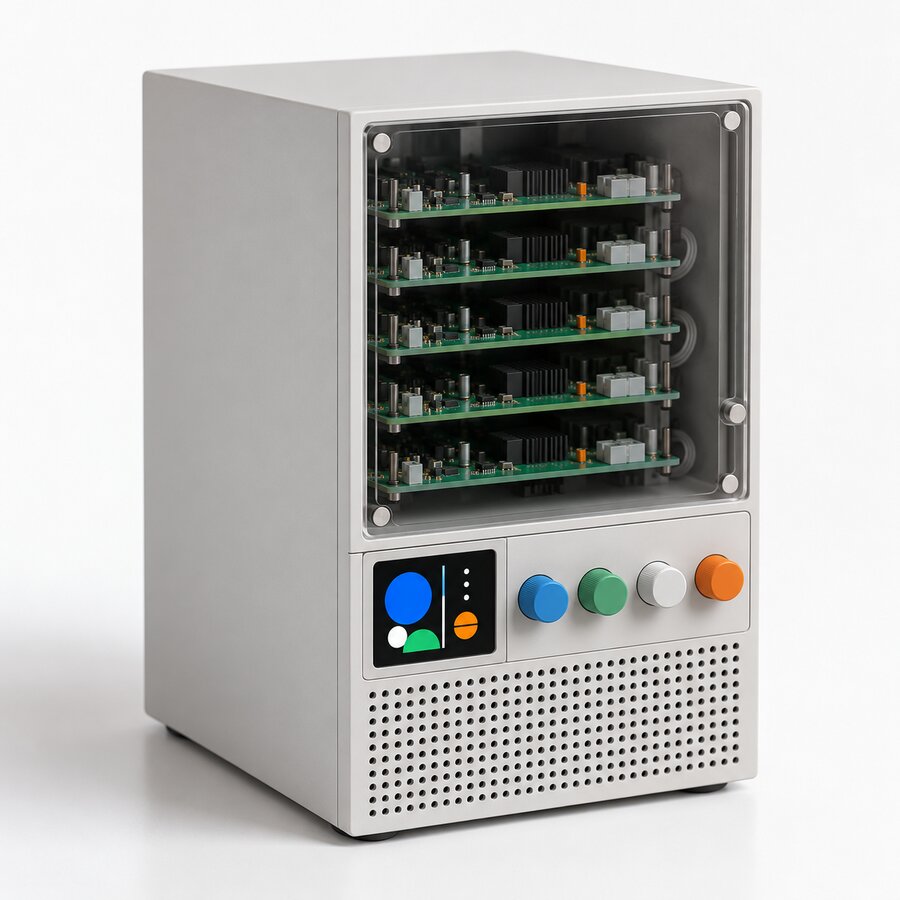
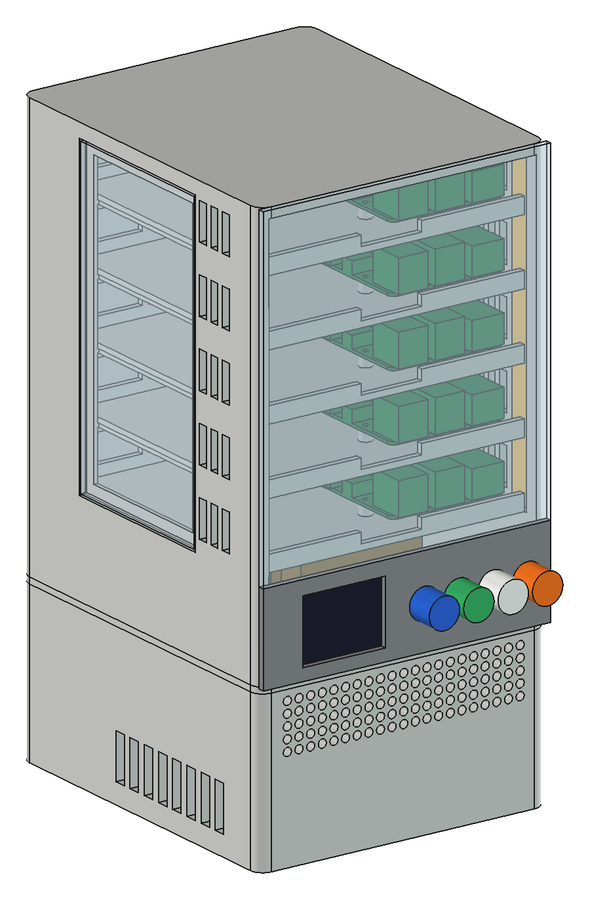
The OP-1's four knobs are blue, green, white and orange, and each colour matches a value on the screen. The colour is the interface.
So T2 gets real knobs. It's A2 with the control bay turned into an OP-1 face: the screen on the left and four encoders on the right. Blue sets the fan speed, green the light brightness, white the light colour, and orange flips the screen's page. The screen draws each value in its knob's colour. The plinth's intake becomes a speaker-style grid of round holes.
It's the only design in the whole project with controls I can actually use, and that's why it's Claude's pick of the batch.
T3 Pocket
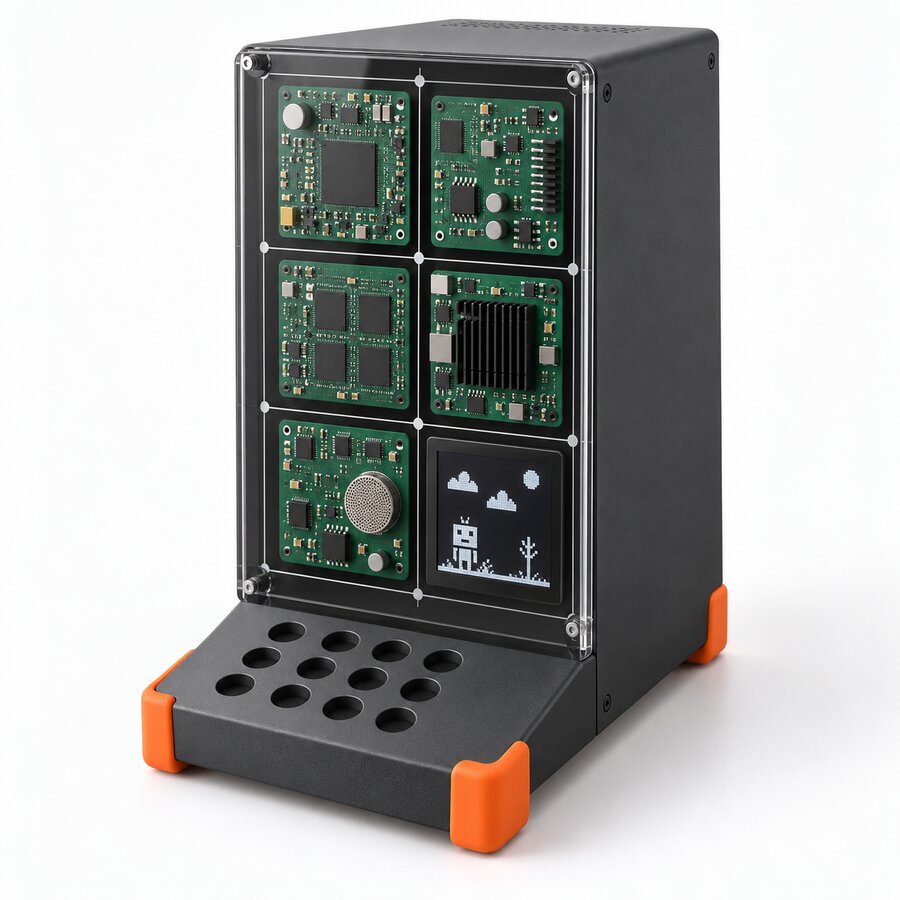
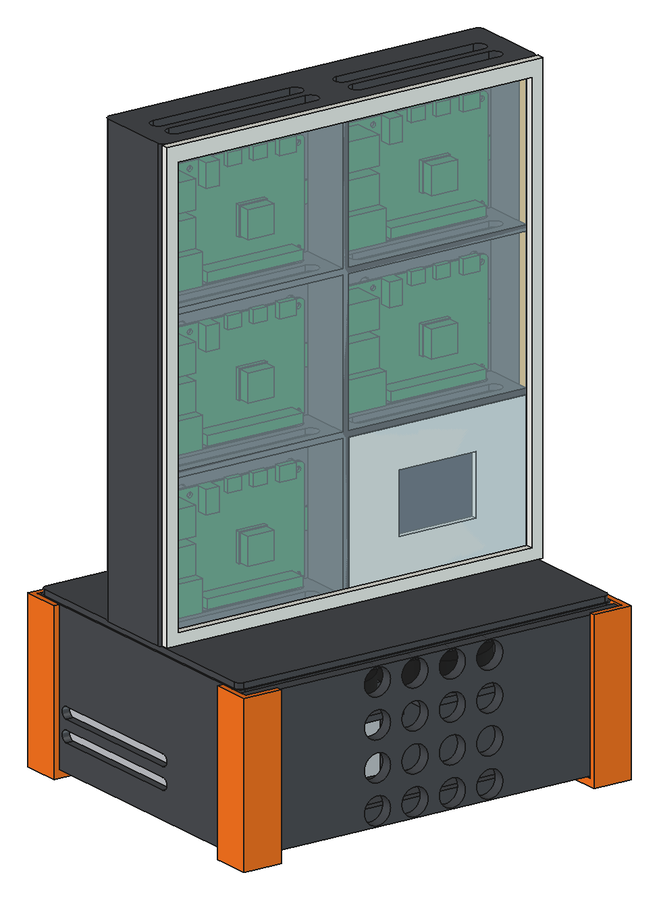
Pocket Operators are sold as bare circuit boards with a calculator keypad and a tiny display, and you can buy a silicone case for them if you want. The board is the product.
T3 takes N4 from the Neo-Braun round (6.1), the slab with every board face on, and makes it a giant Pocket Operator. The five boards are the "components" behind a white "silkscreen" frame, the screen sits in the sixth cell, and the base's front is a 4 × 4 keypad of round holes, which is the intake. Orange TPU bumpers wrap the corners like the silicone case and act as feet. That fixes something in N4: its floor slots sat flat on the desk. It still shares N4's weakness, though: the boards in each column breathe each other's air.
The numbers
| T1 | T2 | T3 | |
|---|---|---|---|
| After | computer-1 | OP-1 | Pocket Operator |
| Size, W × D × H (mm) | 156 × 162 × 224 | 142 × 186 × 287 | 207 × 165 × 318 |
| Boards seen | Edge on, through the front | On trays, door and sides | Face on, all five |
| Push at the top to tip it | 4.7 N | 4.6 N | 3.9 N |
| Mass, of which printed | 1.43, 0.46 kg | 1.91, 0.80 kg | 1.78, 0.70 kg |
That's twenty-three designs, all passing every check with no ballast.